
Aviation
Final batch of Nigerians evacuated from South Africa arrives in Lagos

By Our Reporter
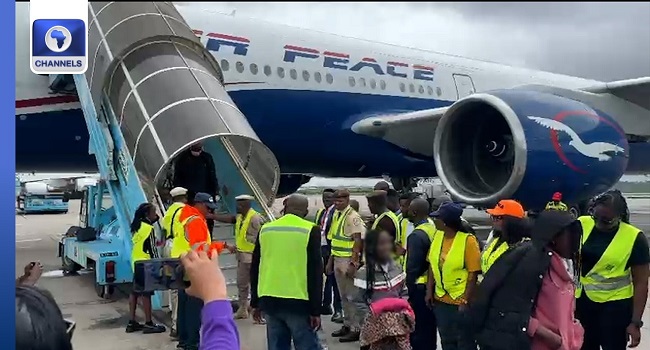
The final batch of Nigerians evacuated from South Africa following recent xenophobic attacks arrived in Lagos on Wednesday, bringing to an end the Federal Government’s emergency repatriation exercise for citizens who voluntarily chose to return home.
The returnees arrived aboard an Air Peace flight that landed at the Murtala Muhammed International Airport, Lagos, at approximately 11:28 a.m., according to Channels Television.
The Ministry of Foreign Affairs said the flight marked the conclusion of the Federal Government’s evacuation programme, which was launched after renewed xenophobic attacks and anti-immigrant violence in parts of South Africa forced many Nigerians to seek voluntary repatriation.
Before the arrival of the flight, the Minister of Foreign Affairs, Bianca Odumegwu-Ojukwu, disclosed that more than 300 Nigerians were expected on the final evacuation mission.
Announcing the departure of the aircraft from Johannesburg earlier on Wednesday, the minister wrote on her X account:
“The last Federal Government-sponsored flight conveying our nationals home from South Africa as a result of the xenophobic protests and attacks on black migrants which have engulfed that country departed O.R. Tambo International Airport, Johannesburg this morning at 6:30 a.m. South African time.”
She added that the aircraft was expected to arrive in Nigeria at about 11:30 a.m.
According to the minister, the latest flight carried 308 Nigerian nationals and three government officials, bringing the total number of citizens evacuated during the exercise to more than 1,500.
A day earlier, Odumegwu-Ojukwu had shared a video showing Nigerian nationals departing the Nigerian High Commission in Pretoria for O.R. Tambo International Airport ahead of their journey home.
The Ministry of Foreign Affairs reaffirmed the Federal Government’s commitment to protecting Nigerians living abroad and expressed appreciation to the agencies and stakeholders that supported the evacuation exercise.
Before Wednesday’s operation, the government had completed six evacuation flights, including the previous mission that returned 40 Nigerians to the country.
The evacuation programme was restricted to citizens who voluntarily registered to return home following the attacks.
The repatriation exercise follows months of renewed xenophobic violence in South Africa, where attacks targeting foreign nationals have reportedly persisted since April.
Several Nigerians and other African migrants were affected by the unrest, with reports of deaths, injuries, destruction of businesses and loss of property.
As tensions escalated, dozens of Nigerians reportedly sought refuge at the Nigerian High Commission in Pretoria while awaiting evacuation.
The attacks have sparked widespread condemnation across Nigeria and other African countries.
The Federal Ministry of Foreign Affairs condemned the violence and warned that Nigeria would consider further diplomatic measures if attacks on its citizens continued.
Similarly, Senator Abdul Ningi, representing Bauchi Central Senatorial District, called on the Federal Government to review its diplomatic relations with South Africa over the recurring attacks on Nigerians.
Air Peace Chairman and Chief Executive Officer, Allen Onyema, also urged Nigerians to suspend investments in South Africa and boycott the country’s economy in protest against the renewed xenophobic attacks.
While advocating economic pressure, Onyema appealed to Nigerians to remain peaceful and avoid reprisals or actions that could threaten South African businesses operating in Nigeria.
The completion of the evacuation exercise marks the end of the Federal Government’s immediate response to the latest wave of xenophobic violence, although concerns remain over the safety and welfare of Nigerians who continue to live and work in South Africa.

By Reporter
The Federal Government has commenced plans to seek compensation from the South African government for Nigerians who were forced to abandon businesses, homes and other assets amid recurring anti-immigrant protests in the country.
The Acting Nigerian High Commissioner to South Africa, Alexander Ajayi, disclosed this during an appearance on Channels Television’s The Morning Brief, saying Nigerian authorities have begun documenting businesses and properties left behind by citizens returning home voluntarily.
According to Ajayi, the exercise forms part of a broader strategy to engage South African authorities on compensation for economic losses suffered by Nigerians displaced by the latest wave of anti-immigrant tensions.
He explained that many Nigerians opted to return before planned protests escalated, prompting the government to immediately begin compiling an inventory of their abandoned assets.
“In terms of the businesses, just three days ago, myself and the South African Deputy Minister of Finance were together and we were discussing this. I took up the discussion with her and we have agreed that we are going to ask our people who are returning to begin to document what they are leaving behind,” Ajayi said.
“I have asked them before they left yesterday to document very accurately those things they were leaving behind in terms of businesses, in terms of even cars, movable and immovable properties. We can now take it up with the South African government. That is the next step we are going to take.”
He stressed that the government’s intervention would extend beyond evacuating affected citizens.
“This repatriation will not end with just taking people to Nigeria. We are going to systematically follow up on the information given to us… because we are going to work with the South African government to get to the exact locations of all these businesses, shops and properties and present them to the South African government for possible compensation because we will not allow the labour people have suffered to build over the years to just go down the drain or be taken over by people,” he added.
Ajayi also challenged claims that most Nigerians in South Africa are undocumented migrants, arguing that many entered the country legally but became victims of prolonged administrative delays in the country’s immigration system.
“In the last three or four years there have been a deluge of applications at the South African Home Office which were not attended to due to systemic issues. So, because of this many, not only Nigerian nationals, were caught in this web of delay,” he said.
He maintained that many Nigerians awaiting permit renewals or residency documentation should not be classified as undocumented, noting that some applications had remained pending for years.
The move comes as dozens of Nigerians sought refuge at the Nigerian High Commission in Pretoria following fears of renewed xenophobic violence linked to planned anti-immigrant demonstrations.
A video circulated by News Central on Monday showed scores of Nigerians gathered at the mission, with women and children reportedly given priority accommodation while awaiting evacuation arrangements.
Foreign affairs and international law experts say Nigeria’s move signals a stronger diplomatic response to recurring xenophobic incidents but caution that securing compensation may prove challenging.
A former Nigerian diplomat, Olujimi Olusanya, said any compensation process would require comprehensive documentation linking losses directly to violence or the failure of authorities to provide adequate protection.
“The success of such claims will depend largely on credible evidence, diplomatic negotiations and the willingness of South African authorities to address the grievances through established legal and bilateral mechanisms,” he said.
Similarly, international relations analyst Kabiru Adamu noted that while states have a responsibility to protect all lawful residents within their borders, compensation claims are often resolved through negotiations rather than litigation.
He added that the documentation exercise announced by the Nigerian High Commission would strengthen the government’s position during discussions with South African officials.
Analysts also argue that beyond compensation, the recurring incidents underscore the need for Nigeria and South Africa to deepen cooperation on migrant protection, law enforcement and early-warning mechanisms to prevent future outbreaks of xenophobic violence.
The latest development comes against the backdrop of repeated attacks on foreign nationals in South Africa over the past decade, incidents that have periodically strained diplomatic relations between Africa’s two largest economies and raised concerns over the safety of migrants and foreign-owned businesses.
 Reporter
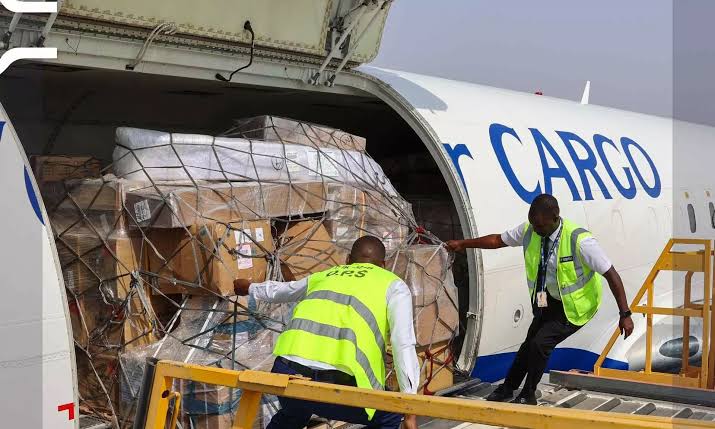
African airlines recorded the strongest air cargo demand growth of any region in the world in May 2026, outperforming global peers as expanding trade and resilient demand along the Africa–Asia corridor continued to boost the continent’s aviation sector.
According to the International Air Transport Association’s (IATA) latest Air Cargo Market report, African carriers posted a 13.3 per cent year-on-year increase in cargo demand in May, more than double the 6.0 per cent global growth recorded during the same period.
Despite the strong demand, cargo capacity among African airlines rose by just 1.3 per cent, highlighting continued pressure on available freight space.
“African airlines saw a 13.3 per cent year-on-year increase in demand for air cargo in May, the strongest performance of all regions. Capacity increased by 1.3 per cent year-on-year,” IATA said.
Globally, total air cargo demand, measured in cargo tonne-kilometres (CTK), increased by 6.0 per cent compared with May 2025, while international cargo demand rose 6.5 per cent. Total cargo capacity, measured in available cargo tonne-kilometres (ACTK), grew by 1.9 per cent globally and 2.8 per cent for international operations.
IATA attributed the overall growth to stronger global trade and manufacturing activity, despite continuing geopolitical tensions and economic uncertainty.
Global trade expanded by 5.0 per cent year-on-year in May, marking the 25th consecutive month of annual growth, while manufacturing activity remained in expansion territory.
However, the association noted that export demand remained relatively weak. Although the Global Manufacturing Output Purchasing Managers’ Index (PMI) rose to 53.5, the New Export Orders Index remained below the 50-point threshold at 49.6, suggesting that cargo growth was concentrated in specific trade lanes rather than reflecting broad-based export expansion.
North American airlines recorded the second-fastest cargo demand growth, with volumes increasing 10.5 per cent, followed by Asia-Pacific (8.0 per cent) and Europe (6.7 per cent). Latin American and Caribbean carriers posted a modest 1.9 per cent increase.
The Middle East was the only region to record a decline, with cargo demand falling 8.9 per cent and capacity dropping 9.2 per cent as regional conflict continued to disrupt cargo operations and trade flows.
Across major trade routes, the Asia–North America corridor recorded the strongest cargo growth in May, followed by Africa–Asia, intra-Europe and Europe–Asia. In contrast, Gulf-linked trade corridors remained significantly affected by the conflict in the Middle East.
Jet fuel prices declined by 16.3 per cent month-on-month in May, easing operating costs for airlines, although prices remained 93.5 per cent higher than a year earlier.
The latest figures extend Africa’s strong performance in global air cargo markets throughout 2026. African airlines recorded demand growth of 18.2 per cent in January, 21 per cent in February, 7.0 per cent in March and 7.7 per cent in April, underscoring sustained momentum driven largely by growing trade volumes between Africa and Asia.
The upward trend also reflects gains recorded toward the end of 2025, when African carriers posted double-digit cargo growth in both November and December, reinforcing the continent’s emergence as one of the fastest-growing regions in the global air freight market.


Customs: Salako takes charge at Lilypond Export Command, pledges stronger trade facilitation

Eid-el-Maulud: Rite Foods calls for peace, unity, national progress

Rite Foods’ innovation, green energy drive earns top 50 impact recognition
-

 Fashion9 years ago
These ’90s fashion trends are making a comeback in 2017
-
Fashion9 years ago
Model Jocelyn Chew’s Instagram is the best vacation you’ve ever had
-
Entertainment9 years ago
The final 6 ‘Game of Thrones’ episodes might feel like a full season
-
Fashion9 years ago
According to Dior Couture, this taboo fashion accessory is back
-
Sports9 years ago
Steph Curry finally got the contract he deserves from the Warriors
-

 News9 months ago
Tinubu opens first stretch of Lagos–Calabar Coastal Highway, hints on ₦trillion legacy roads push
-
Entertainment9 years ago
The old and New Edition cast comes together to perform
-
Business9 years ago
Uber and Lyft are finally available in all of New York State