Oil & Gas
Nigeria’s downstream sector enters investment-led growth phase – NMDPRA

By Ambrose Nnaji
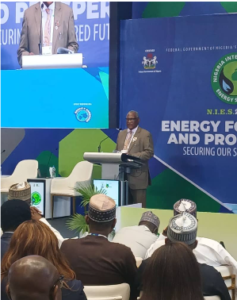
Nigeria’s downstream petroleum sector is entering a new phase marked by market stability, regulatory discipline and rising investor confidence, the Chief Executive of the Nigerian Midstream and Downstream Petroleum Regulatory Authority (NMDPRA), Saidu Mohammed, has said.
Speaking while delivering a keynote address titled “Driving Nigeria’s Downstream Renaissance: Regulation, Investment, and Market Confidence,” at the ongoing Nigeria International Energy Summit (NIES2026), in Abuja, Mohammed said long-standing structural challenges in the sector—ranging from import dependence and weak infrastructure to regulatory non-compliance and inefficient distribution—are being systematically dismantled through deregulation and increased private sector participation.
“For decades, the downstream market was characterised by inadequate infrastructure, inefficient supply chains, limited investment and weak operational safety. That narrative is now changing as the market becomes increasingly driven by fundamentals,” he said.
Central to the reforms, Mohammed noted, is Nigeria’s determination to end its near-total reliance on imported petroleum products and reposition the country as a refining and distribution hub for West Africa and the broader African continent.
According to him, expanding domestic refining capacity is opening up opportunities for supply security and export-led growth, enabling Nigeria’s transition from a crude oil exporter to a value-added energy economy.
“The objective is to move from 100 per cent importation to zero importation, and then scale exportation,” Mohammed stated.
He explained that full deregulation of the downstream market; increased gas utilisation and the adoption of naira-based trading for petroleum products have already delivered measurable macroeconomic gains. Nigeria, he disclosed, avoided estimated economic losses of about ₦6 trillion within nine months of 2025 by significantly reducing foreign exchange outflows previously linked to fuel imports.
“The energy sector must become a net generator of foreign exchange, not a drain on it,” he said, adding that the reforms align with the broader economic agenda of President Bola Ahmed Tinubu.
Beyond liquid fuels, Mohammed identified natural gas as a key pillar of Nigeria’s industrialisation and energy transition, anchored on the Federal Government’s “Decade of Gas” initiative. He said the programme is focused on building a commercially viable gas market supported by infrastructure development and bankable contracts.
He added that government priorities include gas-to-power, industrialisation, clean cooking, transportation and manufacturing, while driving deeper value addition.
“Nigeria should not only transport or export gas. We must convert it into higher-value products such as fertilisers, ammonia and urea,” he said.
Mohammed stressed that NMDPRA’s regulatory framework is designed to de-risk investments rather than hinder them; noting that permits and licences are issued only after confirming the economic viability of proposed projects.
“Investment flows where there is stability, clarity and predictability,” he said, adding that even small-scale projects, including retail filling stations, must align with national infrastructure and economic plans.
On infrastructure, Mohammed said Nigeria must return to more efficient product distribution systems, particularly pipeline-based transportation connected to refinery hubs, noting that government funding alone can no longer meet the scale of required investments.
“The downstream renaissance we seek will be driven by private capital,” he said, outlining plans to develop new pipeline networks from refineries and phase out obsolete corridors with declining commercial relevance.
Describing confidence as the “currency” of functional energy markets, Mohammed said NMDPRA is enforcing stricter commercial discipline in the gas sector through firm Gas Sales Agreements, payment guarantees and clearly defined shipping rights.
“Market confidence is built through consistent actions, not declarations,” he said.
He concluded by emphasising the need for collaboration among regulators, investors, operators, financiers and consumers to sustain Nigeria’s downstream transformation.
“Our responsibility is to set fair rules and enforce them transparently. The responsibility of the market is to invest, innovate and operate responsibly,” Mohammed said, reaffirming NMDPRA’s commitment to positioning Nigeria as one of Africa’s most competitive energy markets.