News
Joe-Ezigbo pushes for more women CEOs in energy sector at IWD 2026


By Ambrose Nnaji
The Chief Executive Officer of Falcon Corporation Limited, Audrey Joe‑Ezigbo, has called on Nigeria’s energy industry to sustain the momentum in appointing women to top leadership positions, especially across the gas value chain, as the sector commemorates International Women’s Day 2026.
Joe-Ezigbo made the call while reflecting on the growing number of women occupying executive positions in Nigeria’s oil, gas, and power industries, describing the trend as a significant shift in a sector historically dominated by men.
Founded in 1994, Falcon Corporation is a wholly indigenous energy firm with operations spanning the midstream and downstream segments. The company serves as the licensed Local Distribution Company responsible for developing and operating gas infrastructure supplying natural gas to industrial and commercial customers in Ikorodu, Lagos State.
Falcon has also expanded into the Liquefied Petroleum Gas (LPG) market through trading, distribution, and infrastructure investments, including an LPG tank farm and jetty facility.
The company is part of Optimera Energy, a consortium implementing a long-term gas infrastructure development project in partnership with the Lagos Free Zone Company to build and operate a gas distribution network serving businesses within the zone.
With strong corporate governance and operational discipline, Falcon continues to strengthen its position in the market, supported by its ‘A’ long-term and ‘A1’ short-term credit ratings from Agusto & Co., reflecting financial stability and sound management.
Joe-Ezigbo noted that the current decade has witnessed a remarkable rise in female leadership across Nigeria’s energy sector, citing key appointments that signal a gradual but meaningful transformation in industry governance.
She highlighted notable leaders including Olu Verheijen, Special Adviser to the President on Energy; Oritsemeyiwa Eyesan, Chief Executive Officer of the Nigerian Upstream Petroleum Regulatory Commission; Folake Soetan; Jennifer Adighije; Wola Joseph‑Condotti; Elozino Olaniyan; Catherine Uju Ifejika; and Seinye Lulu‑Briggs, as examples of women shaping the future of the industry.
According to her, the increasing willingness of boards, regulators, and investors to entrust women with complex and capital-intensive responsibilities reflects growing maturity within the sector and recognition that leadership competence is not defined by gender.
She stressed that the gas sector remains central to Nigeria’s industrialisation and energy security agenda, adding that diversity in leadership must accompany ongoing investments in pipelines, distribution networks, and domestic gas utilisation.
Joe-Ezigbo said inclusive succession planning should become institutional practice rather than isolated milestones, noting that sustained progress will ensure the next generation of female engineers, economists, and executives inherit a sector defined by merit, opportunity, and equal access to leadership.
She added that International Women’s Day 2026 provides an opportunity for the industry not only to celebrate achievements but also to consolidate the gains already made in building a more inclusive and resilient energy sector.

By Editor
Rite Foods Limited and Promasidor Nigeria have called for stronger family support systems, improved child wellbeing, and greater efforts to tackle inequalities affecting millions of Nigerian households as the world marks the 2026 International Day of Families.
The companies, in separate statements commemorating the annual event observed globally on May 15, stressed the need for collective action to address disparities in access to nutrition, education, healthcare, and economic opportunities that continue to impact children and vulnerable families.
This year’s theme, “Families, Inequalities and Child Wellbeing,” highlights growing concerns over widening social and economic gaps and their effects on child development and family stability.
Rite Foods said the occasion aligns with its broader commitment to supporting Nigerian families through quality products, responsible business practices, and people-focused initiatives.
Speaking on the significance of the day, the Managing Director of Rite Foods, Seleem Adegunwa, described families as the foundation of every society, noting that unequal access to essential needs often leaves children most vulnerable.
“Families are at the heart of every society. When access to nutrition, education, healthcare, and opportunity becomes unequal, children are often the most affected. At Rite Foods, we believe every child deserves the chance to grow, thrive, and dream bigger regardless of background,” he said.
Adegunwa added that the company remains committed to delivering quality products that cater to the needs of Nigerian families while maintaining strong connections with everyday consumer realities.
Rite Foods’ product portfolio includes Bigi Carbonated Soft Drinks, Fearless Energy Drinks, Sosa Fruit Drink, Bigi Premium Table Water, Rite Spicy, Bigi Beef, and Bigi Flex Sausages, consumed across different parts of the country.
Also speaking, the company’s Head of Corporate Affairs and Sustainability, Ekuma Eze, stressed the importance of collaboration among businesses, communities, and policymakers in addressing inequality and improving child welfare.
“Real progress happens when businesses, communities, and policymakers work together. Supporting families goes beyond the products we make. It is about creating environments where people feel supported, included, and empowered to succeed,” he said.
Similarly, Promasidor Nigeria emphasised the importance of investing in family welfare and child development as critical pillars for sustainable national growth.
According to the company, conversations around child wellbeing should go beyond awareness campaigns and translate into long-term investments that strengthen family structures and improve access to nutrition and opportunities.

The Chief Executive Officer of Promasidor Nigeria, François Gillet, said the wellbeing of children reflects the strength of society’s foundations.
“Families are the foundation of every society, and the well-being of children reflects the strength of that foundation. Addressing inequalities that limit access to proper nutrition and care is essential to sustainable development,” he said.
Gillet noted that Promasidor’s mission has consistently focused on making quality nutrition accessible to households, especially amid current economic pressures facing many Nigerian families.
Promasidor’s brands, including Cowbell, Loya Milk, Onga, Top Tea, Kremela, Twisco, and Miksi, continue to support nutrition and daily nourishment in millions of homes nationwide.
The company also highlighted its broader social impact initiatives, including the Ikun Dairy Farm in Ekiti State, which promotes local economic inclusion, as well as education-focused programmes aimed at empowering young Nigerians.
Promasidor stated that improving child wellbeing requires sustained investments in systems and policies that strengthen families and create equal opportunities for children to grow in safe, healthy, and supportive environments.
Both companies reiterated that stronger families are critical to building resilient communities and fostering long-term national development.
By Editor
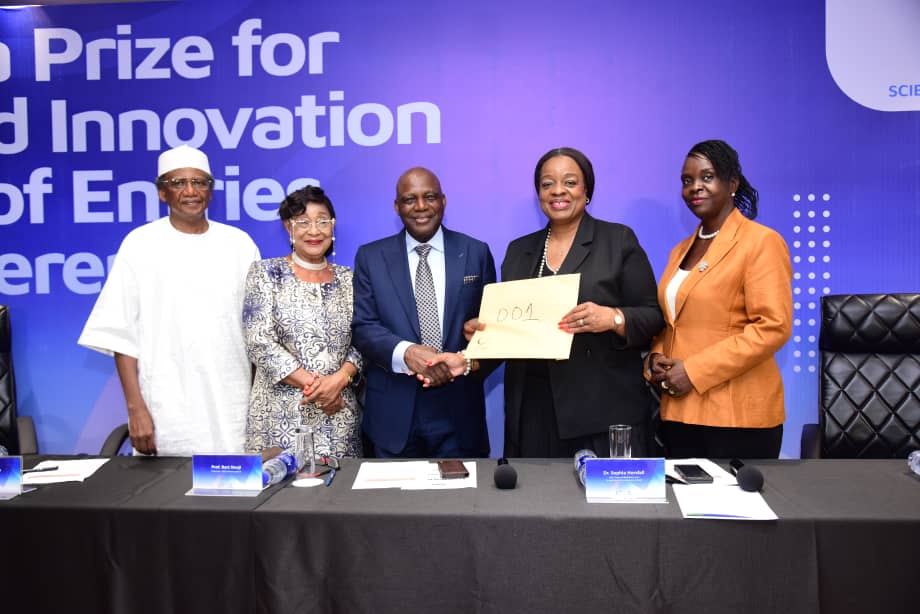
(2nd Right) GM, External Relations and Sustainable Development, NLNG, Sophia Horsfall, presenting entries for The Nigeria Prize for Science and Innovation to the Chairman of the Prize’s Advisory Board, Prof. Barth Nnaji, at a press conference, in Lagos.
The 2026 edition of The Nigeria Prize for Science and Innovation has reached a new milestone with a record 237 entries, the highest number of submissions since the award was established in 2004.
The entries were formally handed over to the Prize’s Advisory Board during a press conference in Lagos on Thursday, officially commencing the adjudication process for what remains one of Africa’s most prestigious science awards.
This year’s competition retains the theme, “Innovations in ICT, Artificial Intelligence (AI), and Digital Technologies for Development,” a continuation of the 2025 focus area. The previous edition ended without a winner after no submission met the benchmark required by the judges.
Speaking at the handover ceremony, Sophia Horsfall, General Manager, External Relations and Sustainable Development at Nigeria LNG Limited, said the continued emphasis on digital innovation reflects both global technological trends and Nigeria’s development priorities.
According to her, the Prize is designed to identify innovations capable of delivering measurable socio-economic impact.
“In this fourth industrial revolution, digital infrastructure is becoming as essential as electricity and water. Nigeria’s economic sustainability depends on our ability to move from promising research to transformative innovation that delivers real solutions,” Horsfall stated.
She stressed that the organisers remain committed to maintaining world-class standards, noting that international recognition for Nigerian innovation must be earned through rigorous evaluation.
“We believe that if a Nigerian discovery is to command global respect, it must withstand the highest levels of scrutiny. That conviction informed the difficult decision taken seven months ago,” she added, referring to the decision not to declare a winner in 2025.
While acknowledging the strong interest generated by the digital technology theme, Horsfall maintained that only innovations demonstrating scalability, originality, and practical relevance would qualify for consideration.
Receiving the entries on behalf of the Advisory Board, Barth Nnaji described the handover as a critical phase in the selection process, reiterating that the credibility of the Prize rests on uncompromising standards of excellence.
“Our refusal to award the prize in 2025 was not a rejection of the efforts of Nigerian innovators. Rather, it reaffirmed that The Nigeria Prize for Science and Innovation upholds a gold standard of excellence,” he said.
Nnaji explained that submissions would continue to undergo rigorous intellectual and technical scrutiny based on originality, depth, relevance, and demonstrable impact.
He added that the Prize is particularly interested in innovations capable of solving real-life national challenges.
“Our broader objective is to identify solutions that address Nigeria’s pressing needs, whether through digital health technologies for underserved communities or AI-driven tools for preserving cultural heritage and indigenous languages,” he noted.
Other members of the Advisory Board include Nike Akande and Yusuf Abubakar.
Now in its 22nd year, The Nigeria Prize for Science and Innovation is valued at $100,000 and is widely regarded as Africa’s leading science and innovation award. The winner of the 2026 edition is expected to be announced at a world press conference in September.

NOG 2026: Nigeria to unveil first-ever gas, power infrastructure map to boost energy investment

Senate orders arrest of Mele Kyari over alleged N210tr NNPCL financial gaps

Consumer complaints trigger FCCPC enforcement action against PWAN
-

 Fashion9 years ago
These ’90s fashion trends are making a comeback in 2017
-
Entertainment9 years ago
The final 6 ‘Game of Thrones’ episodes might feel like a full season
-
Fashion9 years ago
According to Dior Couture, this taboo fashion accessory is back
-
Entertainment9 years ago
The old and New Edition cast comes together to perform
-
Business9 years ago
Uber and Lyft are finally available in all of New York State
-
Sports9 years ago
Steph Curry finally got the contract he deserves from the Warriors
-
Sports9 years ago
Phillies’ Aaron Altherr makes mind-boggling barehanded play
-
Entertainment9 years ago
Disney’s live-action Aladdin finally finds its stars