Connect with us

News

₦30bn loyalty dividend: How BUA turns long service into competitive advantage

Published

on

By Editor

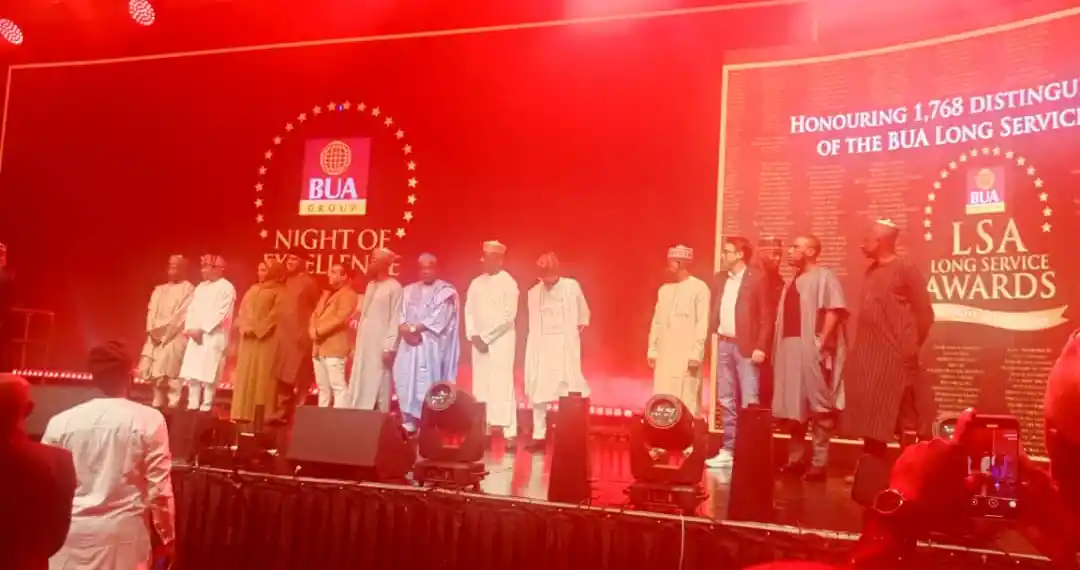
At its 2025 Night of Excellence and Long Service Awards, BUA Group, the diversified Nigerian conglomerate has disbursed a remarkable ₦30 billion in cash awards to 510 employees—one of the largest single employee reward programmes ever undertaken by a private sector company in Nigeria.

But beyond the numbers lies a deeper business narrative about culture, continuity and competitive advantage in an economy where skilled talent retention has become increasingly difficult.

The awards recognised employees whose service spans from five years to more than four decades, honouring loyalty, resilience and exceptional contribution across BUA’s sprawling operations. From cement plants and sugar refineries to food manufacturing, logistics and infrastructure assets, the message was unambiguous: enduring enterprises are built by people who stay the course.

Founded in 1988, BUA Group has grown from modest beginnings into one of Africa’s most diversified industrial groups, with core interests in cement, sugar, flour, pasta, steel, rice, real estate, ports and terminals, construction and energy. Today, its listed entities command a combined market capitalisation running into trillions of naira—an outcome, the company insists, rooted as much in human capital as in financial investment.

Speaking at the ceremony, Founder and Executive Chairman Abdul Samad Rabiu framed the evening as recognition of shared ownership in the BUA journey. He recalled that while capital, strategy and governance matter, none of BUA’s milestones would have been possible without employees who believed in the vision long before success became visible.

“Every factory built, every system strengthened, every challenge overcome, and every milestone reached carries the imprint of employees who believed in the vision long before the results were visible,” Rabiu said.

Of the ₦30 billion disbursed, 41 employees in the highest award categories received their cheques physically from the Chairman during the event, due to time constraints. These awards ranged from ₦100 million to ₦1 billion, underscoring the Group’s willingness to recognise loyalty in tangible, life-changing terms. Sixteen employees received ₦100 million each, nine received ₦200 million, seven received ₦250 million, and three received ₦500 million, while five employees walked away with ₦1 billion each.

A special award, whose cash value was not disclosed at the event, was presented to Kabiru Rabiu in recognition of his exceptional loyalty, leadership and long-standing contribution to the growth and stability of the Group.

The remaining awardees had already received—or will receive—their plaques and cheques at their various plants and operational locations nationwide, reinforcing the Group’s decentralised and inclusive culture.

Rabiu was quick to note that the cash awards, however substantial, remain symbolic. “No amount of money can fully account for decades of dedication, personal sacrifice and belief in the company’s mission,” he said. Still, in a labour market marked by rising emigration, skills shortages and disengagement, the gesture sends a powerful signal.

From a business perspective, the awards also serve a strategic function. By institutionalising long-term rewards, BUA is effectively locking in institutional memory, strengthening loyalty and reinforcing a performance culture that aligns individual success with corporate growth. It is a model of shared prosperity that contrasts sharply with short-term profit-maximisation approaches prevalent in many emerging markets.

Looking ahead, Rabiu said the Group would continue to expand capacity, invest in advanced technologies and deepen its footprint across cement, food, sugar and infrastructure. Crucially, he added, the people who built BUA would continue to grow with it.

The Night of Excellence and Long Service Awards, now a defining element of BUA Group’s culture, reflects an organisation betting that respect for people, long-term thinking and shared rewards are not just moral choices—but sound business strategy.


Continue Reading
Click to comment

Leave a Reply

Your email address will not be published. Required fields are marked *

News

Nigeria positions transparency as economic reform tool ahead of 2026 EITI validation

Published

on

By Editor

Nigeria is sharpening its transparency playbook in the extractive sector, not merely to meet global disclosure benchmarks but to unlock revenue, strengthen governance and restore public trust at a time of sweeping economic reforms.

That message took centre stage in Abuja as the Secretary to the Government of the Federation and Chairman of the NEITI National Stakeholders Working Group (NSWG), Senator George Akume, opened a high-level advocacy dialogue for stakeholders ahead of Nigeria’s 2026 Extractive Industries Transparency Initiative (EITI) Validation.

Addressing civil society leaders, development partners, industry players and government officials, Akume framed transparency as a strategic economic lever rather than a compliance exercise. With Nigeria grappling with fiscal pressures, revenue shortfalls and rising public expectations, he said the extractive sector—long the backbone of government earnings—must be governed with greater openness, efficiency and accountability to realise its full value.

“The extractive sector remains central to Nigeria’s economic stability, revenue mobilisation and long-term development aspirations,” Akume noted, while acknowledging that governance gaps and inefficiencies have historically limited its impact.

A key highlight of the dialogue was the formal introduction of the new Executive Secretary of the Nigeria Extractive Industries Transparency Initiative (NEITI), Musa Sarkin Adar. Akume congratulated him on his appointment and expressed confidence in his ability to steer NEITI at a critical juncture, as transparency reforms increasingly intersect with broader fiscal and economic restructuring.

Significantly, Akume revealed that NEITI’s reports—once viewed largely as diagnostic documents—are now actively shaping policy and reform in Nigeria’s oil, gas and mining sectors. According to him, findings and recommendations from NEITI audits have become essential tools in driving ongoing sector reforms, marking a shift from transparency for transparency’s sake to transparency as a catalyst for change.

The dialogue also spotlighted the rising importance of the 2023 EITI Standard, which places greater emphasis on outcomes rather than disclosures alone. For Nigeria, this means deploying transparency data to plug revenue leakages, improve sector oversight, strengthen institutions and ensure that natural resource wealth translates into tangible benefits for citizens.

“As a country, we must go beyond compliance. EITI should serve as a reform instrument that supports domestic revenue mobilisation, prudent fiscal management and inclusive governance”, Akume said.

Discussions at the forum centred on Nigeria’s recent EITI Assessment, the upcoming Validation process and the unveiling of a policy brief titled “Beyond Assent: Pathways for Implementing Nigeria’s New Tax and Revenue Framework.” The brief, Akume explained, aligns extractive sector governance with the government’s wider economic reform agenda and provides practical pathways for improving tax administration and revenue capture.

Underlying the entire conversation was NEITI’s multi-stakeholder model, which Akume described as the initiative’s greatest strength. He stressed that transparency cannot be delivered by government alone, underscoring the critical roles of civil society, the private sector, sub-national actors, the media and development partners.

“This is why dialogues like this matter. They create space for honest reflection, constructive engagement and shared ownership of reforms”, he said.

As Nigeria prepares for its 2026 EITI Validation, the Abuja dialogue signalled a clear shift in tone and intent: transparency is no longer just a governance ideal, but a business-critical and reform-driven strategy for stabilising revenues, strengthening investor confidence and securing long-term economic resilience.


Continue Reading

News

Tinubu nominates new regulators as Nigeria resets oil, gas oversight

Published

on

By Editor

President Bola Ahmed Tinubu has moved to recalibrate Nigeria’s oil and gas regulatory architecture, nominating two seasoned industry professionals to head the country’s upstream and midstream/downstream regulators at a critical moment for investment, production growth, and reform delivery.

In letters to the Senate, the President requested expedited confirmation of Oritsemeyiwa Amanorisewo Eyesan as Chief Executive Officer of the Nigerian Upstream Petroleum Regulatory Commission (NUPRC) and Engineer Saidu Aliyu Mohammed as Chief Executive Officer of the Nigerian Midstream and Downstream Petroleum Regulatory Authority (NMDPRA).

The nominations follow the resignations of Engineer Farouk Ahmed (NMDPRA) and Gbenga Komolafe (NUPRC), both appointed in 2021 by former President Muhammadu Buhari to lead the regulators established under the Petroleum Industry Act (PIA). Their exits open a new chapter for institutions central to Tinubu’s economic agenda, which prioritises energy security, gas-led growth, and renewed investor confidence.

Eyesan brings nearly 33 years of experience across the Nigerian National Petroleum Company (NNPC) and its subsidiaries, retiring recently as Executive Vice President, Upstream (2023–2024). An Economics graduate of the University of Benin, she previously served as Group General Manager, Corporate Planning and Strategy from 2019 to 2023, a role that placed her at the heart of long-term investment planning, portfolio optimisation, and reform execution. Her nomination signals continuity in upstream policy, with an emphasis on production recovery, fiscal stability, and disciplined capital allocation.

For the midstream and downstream space, Tinubu has tapped Engineer Saidu Aliyu Mohammed, a veteran gas and refining executive with deep operational and policy credentials. Born in 1957 and a Chemical Engineering graduate of Ahmadu Bello University, Mohammed has held some of the industry’s most consequential leadership roles, including Managing Director of Kaduna Refining and Petrochemical Company and Nigerian Gas Company. He also served as Group Executive Director/Chief Operating Officer, Gas & Power, where he helped shape Nigeria’s gas policy architecture, contributing to the Gas Masterplan, Gas Network Code, and the PIA itself.

Mohammed’s track record includes delivery and oversight of landmark projects such as the Escravos–Lagos Pipeline Expansion, the Ajaokuta–Kaduna–Kano (AKK) Gas Pipeline, and Nigeria LNG Train expansions. His recent appointment as an independent non-executive director at Seplat Energy underscores his standing across both public and private sector energy circles.

If confirmed, the two chief executives will inherit regulators under pressure to translate reform into results—streamlining approvals, enforcing compliance, expanding gas infrastructure, and anchoring Nigeria’s ambition to become a competitive, rules-based energy destination.

For markets and investors, the nominations are an early signal of how the Tinubu administration intends to marry experience with execution as it seeks to unlock value across the petroleum value chain.

Continue Reading

News

Tinubu opens first stretch of Lagos–Calabar Coastal Highway, hints on ₦trillion legacy roads push

Published

on

By Editor

The long-delayed Lagos–Calabar Coastal Highway took a major step forward at the weekend with the temporary opening of Section 1, stretching from the Ahmadu Bello Way junction to Eleko Village in Lagos, as the Federal Government pushed to demonstrate delivery on President Bola Ahmed Tinubu’s flagship infrastructure agenda.

The opening, performed on behalf of the President by the Minister of Works, Engr. David Umahi, marks the first visible milestone on one of Tinubu’s four “legacy projects” — a network of strategic highways designed to knit together Nigeria’s economic corridors across all six geopolitical zones.

The Lagos–Calabar Coastal Highway is a proposed inter-state corridor designed to run along Nigeria’s coastal shoreline, linking Lagos to Cross River State. The highway is expected to pass through nine states—Lagos, Ogun, Ondo, Edo, Delta, Bayelsa, Rivers, Akwa Ibom and Cross River—with a spur extending northwards into the North-Central region. When completed, the corridor will span an estimated 75 kilometres.

Within Lagos State, the project covers a total stretch of about 103 kilometres. To ease construction and delivery, the highway has been broken into phases. Section 1, measuring 47.47 kilometres, runs from Chainage 0+00 at Ahmadu Bello Way Junction to Chainage 47+474 at Eleko Village Junction. This section was awarded to Hi-Tech Construction Company Limited at a contract sum of ₦1.067 trillion.

The scope of work includes the construction of a dual-carriage rigid-pavement highway, supported by associated drainages and culverts, median barriers and street lighting. It also covers the relocation of critical public utilities, including electricity cables and poles, cable ducts, as well as gas and water pipelines, where required.

Umahi said Section 1 covers about 47.47 kilometres of six-lane carriageway built with reinforced concrete pavement, equipped with street lighting, CCTV surveillance and rapid-response facilities designed to address incidents within five minutes. Landscaping and extensive tree planting are also integrated into the design, reflecting what the minister described as a “new quality benchmark” for federal highways.

Beyond Lagos, works are progressing simultaneously across multiple sections of the coastal highway. According to the minister, the second section spans about 55 kilometres between Ogun State and the Lagos border, while Sections 3A and 3B — roughly 72 kilometres after redesign — are underway in Cross River and Rivers states. Sections 4A and 4B are progressing in Akwa Ibom and Cross River, reinforcing the administration’s strategy of starting construction from both ends of the corridor.

In total, over 60 kilometres of the 258-kilometre Lagos–Calabar route have been opened to traffic on a temporary basis, while more than 30 kilometres have completed earthworks, Umahi said.

He framed the project as the fulfilment of a vision first conceived nearly five decades ago during the Shehu Shagari administration, when the idea of a Badagry–Sokoto superhighway was first mooted. Under Tinubu, the concept has been reworked into interconnected coastal and inland corridors, including a six-lane Sokoto axis starting from Ilela, where 120 kilometres have already been awarded and construction commenced.

The minister stressed that the coastal highway is only one pillar of a broader national grid of roads. The third legacy project, running from the South-East through the North-Central to Abuja, has seen 120 kilometres awarded in Ebonyi State at a cost of about ₦456 billion, with concrete pavement already progressing on over 10 kilometres. A fourth legacy corridor — recently approved by the Federal Executive Council — will link Akwanga to Jos, Bauchi and Gombe, extending the network into the North-East.

Umahi said the projects are deliberately designed to interconnect, creating continuous trade and logistics routes from the Atlantic coast to the country’s hinterland. He also revealed plans for a privately financed public-private partnership (PPP) section, including a 3.5-kilometre tunnel linking coastal corridors through island communities.

Addressing concerns around cost and transparency, the minister said anti-corruption agencies, including the ICPC and EFCC, have been invited to independently inspect all legacy projects nationwide. He pledged that detailed cost breakdowns — from bills of quantities to evaluation sheets — are available for scrutiny, challenging critics to “query any item line by line.”

For investors and businesses, the administration argues that the roads will lower logistics costs, open up coastal tourism and industrial zones, and improve access to ports, agro-belts and manufacturing hubs. Umahi maintained that despite security, funding and environmental challenges, progress remains “above 95 per cent on the positives.”

“The policy is simple,” he said. “We start from the beginning and from the end at the same time — so the nation can see, touch and use what is being built.”

As traffic begins to flow on the first Lagos stretch, the government is betting that visible delivery — even on a temporary basis — will help build confidence in what is shaping up to be one of Nigeria’s most ambitious road-building programmes in decades.

The Lagos State Governor, Babajide Sanwo-Olu, represented by the Commissioner for Transportation, Oluwaseun Osiyemi, said the temporary opening of the Lagos–Calabar Coastal Highway, Phase 1, Section 1, marks a significant milestone for productivity, commerce and long-term economic growth. Infrastructure of this magnitude goes beyond reducing travel time; it unlocks efficiency across the entire economic value chain, enabling individuals and businesses to focus on productive activity rather than avoidable delays, Sanwo-Olu said.

Currently, journeys along this corridor can take as long as 15 hours. Upon full completion, travel time is expected to be reduced to just a few hours, significantly lowering logistics costs and improving the movement of goods, services and labour. The Governor said broader economic benefits are substantial—faster transit, improved road safety, stronger regional trade linkages and a strategic corridor capable of driving industrial expansion.

According to him, when fully delivered, this project has the potential to boost Nigeria’s Gross Domestic Product by catalysing industrialisation, stimulating trade and enhancing connectivity between key commercial hubs. It will also ease congestion, improve road safety and create a more predictable and efficient transport environment for commuters and businesses.


Continue Reading

Trending