News
Tinubu’s 27-year dream gets name as fed govt renames coastal highway

By 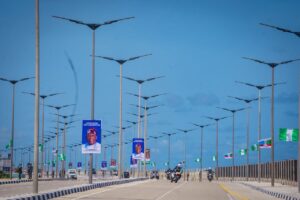

The Federal Government has renamed the Lagos-Calabar Coastal Highway as the President Bola Ahmed Tinubu Coastal Highway, following the completion of Section One of the flagship infrastructure project.
Minister of Works David Umahi announced the decision during a media briefing on Thursday at the ministry’s headquarters in Abuja, describing it as a recognition of President Bola Tinubu’s long-held vision for the 750-kilometre coastal corridor.
According to Umahi, the decision was reached in consultation with the ministry’s leadership, including the Permanent Secretary, Minister of State, directors and other senior officials.
“That coastal highway is named the President Bola Ahmed Tinubu Coastal Highway. By the powers conferred on me as Minister of Works, in consultation with my Permanent Secretary, the Minister of State, directors and staff of the ministry, we decided to name it after him because of his dream for it,” Umahi said.
He noted that Tinubu first conceived the idea nearly three decades ago while serving as Governor of Lagos State.
“It is one thing to dream and another thing to have the grace to actualise that dream. This is one man who dreams and has the grace and divine mandate to actualise that dream,” he added.
Umahi disclosed that the first section of the highway, stretching 47.47 kilometres from Victoria Island to Lekki, is a six-lane carriageway with a 25-metre-wide median reserved for a future railway line.
The minister also announced that President Tinubu had approved a 400-kilometre extension of the Fourth Legacy Highway, increasing its total length from about 700 kilometres to 1,100 kilometres.
The expanded route will run from Akwanga in Nasarawa State through Jos, Bauchi, Gombe and Biu to Maiduguri, with an additional extension into Taraba State.
He further disclosed that the President had approved the dualisation of another 400 kilometres of the East-West Road, the reconstruction of sections of the Lagos-Ibadan Expressway using reinforced concrete pavement technology, the completion of the abandoned Ibi Bridge in Taraba State and the construction of the 5.76-kilometre Lao Bridge.
According to Umahi, the projects are designed to improve transport connectivity, boost economic activities and modernise Nigeria’s road infrastructure.
He described the approvals as part of the Tinubu administration’s broader commitment to delivering strategic infrastructure that supports national economic growth and regional integration.
The Lagos-Calabar Coastal Highway is one of the Federal Government’s flagship road projects, intended to improve connectivity along Nigeria’s southern coastline while promoting trade, tourism and investment.
In April 2024, Umahi disclosed that the project would be completed over eight years, with delivery in phases throughout President Tinubu’s tenure.
The first phase, covering approximately 47.7 kilometres from Ahmadu Bello Way to the Lekki Deep Sea Port in Lagos State, is expected to be completed within 36 months.