Energy
REA breaks ground on 1.5MW Plateau mini-grid, advances 48-project national rollout

By Editor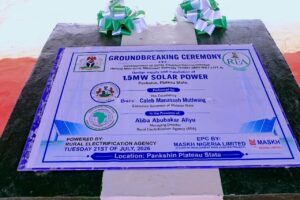

The Rural Electrification Agency (REA) has commenced the development of a 1.5-megawatt (MW) interconnected mini-grid in Pankshin, Plateau State, as part of its nationwide drive to expand electricity access and strengthen power infrastructure in underserved communities.
The groundbreaking ceremony comes shortly after the commissioning of a 50-kilowatt Access to Markets and Agriculture (AMP) Solar Mini-Grid in Namu Community, Plateau State, and follows similar groundbreaking events for interconnected mini-grid projects in Kogi (20MW), Kebbi (3.5MW), Adamawa (27MW) and Rivers (12MW) states.
Speaking at the ceremony, REA Managing Director, Abba Aliyu, said the Pankshin project forms part of a broader national rollout of 48 interconnected mini-grids designed to improve electricity reliability and support economic development across Nigeria.
According to him, the project will enhance power quality, reduce technical losses on existing distribution networks and provide dependable electricity to support agro-processing, healthcare facilities and commercial activities.
Aliyu also commended Plateau State Governor Caleb Mutfwang for fostering an enabling environment that encourages private sector investment in the state’s power sector.
He disclosed that the agency is currently constructing 10 additional mini-grid projects in Plateau under the Distributed Access through Renewable Energy Scale-up (DARES) Programme, covering Langtang South, Qua’an Pan, Shendam, Mikang, Wase, Kanke, Kanam, Mangu and other benefiting local government areas.


The REA boss explained that interconnected mini-grids are designed to complement existing distribution infrastructure by easing network constraints, improving power quality, reducing technical losses and supplying additional electricity where demand is highest.
He added that beyond improving electricity access, the projects are expected to stimulate local economic growth by providing businesses and productive enterprises with reliable power.
“The objective is to ensure electricity becomes a catalyst for production, job creation and economic development, rather than merely a source of consumption,” he said.
Industry experts have welcomed the initiative, describing interconnected mini-grids as a practical solution to Nigeria’s persistent electricity access challenges, particularly in rural and underserved communities.


They noted that while grid expansion remains essential, distributed renewable energy systems are increasingly becoming a cost-effective way of improving electricity reliability and supporting productive economic activities.
Energy economists say reliable electricity remains one of the biggest obstacles facing micro, small and medium-sized enterprises (MSMEs), especially in agriculture, processing, healthcare and education, where high energy costs continue to limit productivity.
According to the experts, projects such as the Pankshin mini-grid could help lower businesses’ dependence on diesel generators, reduce operating costs and improve the competitiveness of rural enterprises.
They also pointed out that interconnected mini-grids differ from isolated mini-grids because they work alongside existing distribution networks, supplying additional electricity where demand is high while helping to improve voltage stability and reduce technical losses.
However, the experts cautioned that the long-term success of the projects would depend on sustained maintenance, commercially viable tariff structures, strong community participation and effective collaboration between mini-grid developers, electricity distribution companies and regulators.
They further observed that the rollout aligns with Nigeria’s ambition to achieve universal electricity access by 2030 and could attract greater private investment into renewable energy infrastructure if implementation remains consistent.
According to them, expanding interconnected mini-grids across the country would not only improve electricity supply but also stimulate local industries, create jobs, enhance food processing and strengthen Nigeria’s transition to a cleaner and more resilient energy system.
The REA has continued to scale up renewable energy deployment through its DARES Programme and other electrification initiatives as part of efforts to close Nigeria’s electricity access gap and improve energy security.