News
NPC launches digital birth, death registration as millions of vital events go unrecorded

By Our Reporter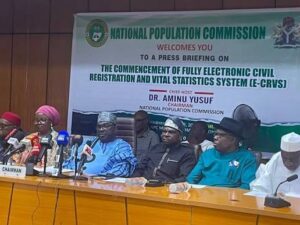

Nigeria records an estimated five million births every year, yet millions of births and deaths still go undocumented, according to the National Population Commission (NPC).
The Commission disclosed that birth registration coverage has risen to 57percent, while death registration remains below 20percent, highlighting persistent gaps in the country’s civil registration system.
The disclosure coincided with the nationwide launch of VitalReg, a digital platform for registering births and deaths under the Electronic Civil Registration and Vital Statistics (e-CRVS) system.
Speaking at a press briefing in Abuja, NPC Chairman, Aminu Yusuf, said inadequate registration continues to deny millions of Nigerians legal identity and deprive the country of reliable demographic data needed for effective planning and policymaking.
“These gaps deprive many Nigerians of legal identity and limit the availability of reliable data needed for effective national planning,” Yusuf said.
According to the NPC chairman, the VitalReg platform became operational across the 36 states and the Federal Capital Territory on July 1, marking a major milestone in the modernisation of Nigeria’s civil registration system.
He explained that the platform is designed to simplify birth and death registration through digital services, including 24-hour online access, electronic certificate issuance, faster processing, reduced paperwork and enhanced data verification.
Yusuf said the new system would improve the credibility of Nigeria’s Civil Registration and Vital Statistics (CRVS) database while providing a foundational data source for other government information systems.
He added that the platform is expected to strengthen interoperability across Nigeria’s digital identity ecosystem in line with the Federal Government’s digital transformation agenda.
To improve access to registration services nationwide, the commission said it has established 4,011 functional registration centres across the country’s 774 local government areas, with plans to expand the network to approximately 8,000 centres.
Yusuf noted that the NPC is also working with key stakeholders to strengthen the capacity of registration officers and ensure births and deaths are recorded promptly and accurately through the new digital system.
As part of efforts to decentralise registration services, the Commission announced a partnership involving the Association of Local Governments of Nigeria (ALGON), the National Identity Management Commission (NIMC), UNICEF, and Barnksforte Technologies Limited to bring registration services closer to communities.
The NPC also announced a review of fees for specialised administrative services, including record modifications, certificate reissuance, attestation and verification requests.
However, Yusuf assured Nigerians that birth registration and birth notification services would remain highly subsidised to encourage universal registration.
“Let me assure Nigerians that this review is not intended to create barriers to access. Birth registration and birth notification services remain highly subsidised, in line with the commission’s commitment to achieving universal registration,” he said.
He explained that the VitalReg platform is being operated under a Public-Private Partnership (PPP) with Barnksforte Technologies Limited, which will provide technical support, maintain system availability, strengthen cybersecurity and implement continuous technology upgrades.
The launch follows a recent partnership between the NPC and the United Nations Children’s Fund (UNICEF) to integrate the National Identification Number (NIN) into Nigeria’s digital birth registration system.
Under the initiative, children can be assigned a NIN at birth, reducing the burden on parents while strengthening the country’s identity management framework.
According to UNICEF, integrating birth registration with the NIN system will also provide government with more reliable population data to support evidence-based policymaking and improve the planning and distribution of essential public services, including healthcare and education.
The NPC said the digital registration initiative is expected to improve legal identity coverage, strengthen demographic statistics and support more effective national development planning.