News
Fashola says Lagos chose long-term gains over land revenue in Dangote Refinery deal

By Editor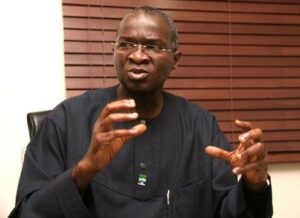

Former Lagos State Governor Babatunde Fashola has revealed that his administration offered the Dangote Group a discounted price for land in the Lekki Free Zone to secure what later became the Dangote Petroleum Refinery, describing the move as a strategic investment that has delivered long-term economic benefits.
Fashola made the disclosure during his keynote address, titled “From Presence to Power: Advancing Women’s Influence in the Boardroom,” at the Chartered Institute of Directors (CIoD) Nigeria Women Directors’ Biennial Conference held earlier this week at the National Arts Theatre in Lagos.
According to him, the decision was influenced by the then Commissioner for Commerce and Industry, Olusola Oworu, who argued that attracting the multibillion-dollar investment would generate far greater returns than insisting on the state’s fixed land pricing policy.
He recalled that after the Dangote Group selected Lagos as its preferred location for the refinery, negotiations over the allocation of about 2,000 hectares of land stalled because the company considered the government’s asking price too high.
At the time, Lagos maintained a fixed-rate pricing system for land allocations, prompting debate within the State Executive Council over whether to adjust the price.
Fashola recounted Oworu’s intervention before the council: “Look, Governor, you have 16,000 hectares of land. The Chinese are in 3,000 hectares. We have barely built 200. Thirteen thousand is waiting for investors. You have now found an investor who wants to take 2,000 hectares and build a refinery of $19 billion and you are quibbling over the cost of the land. Offer the land at a discount. Once it comes in, others will follow. And then you can make money from your land.”
Fashola said the argument convinced the council to approve the concession.
“That was a thinking decision. And the whole of council then looked to me and I surrendered,” he said, noting that Oworu’s intervention ultimately changed the course of the deliberations.
Using the episode to underscore his keynote message on leadership, Fashola said effective leadership is defined by competence rather than gender.
“Ineffectiveness is not a gender thing; it is a human thing,” he said, adding that women should be evaluated based on their preparation, capability and impact, not merely on representation.
The conference also featured renewed calls for organisations to move beyond increasing the number of women on corporate boards and focus instead on giving them greater influence over strategic decision-making.
CIoD Nigeria First Vice-President, Amina Oyagbola, observed that although more women now serve on corporate boards and lead public and private institutions, they remain underrepresented in board chair and executive leadership positions where major decisions are made. She called for stronger mentorship and sponsorship programmes to develop more women leaders.
Similarly, CIoD Nigeria President and Chairman of the Governing Council, Otunba Adetunji Oyebanji, said board appointments should be based on competence, integrity and skills rather than traditional leadership pathways that have historically limited women’s access to top positions.
He added that strengthening women’s influence in boardrooms has become increasingly important as organisations navigate economic uncertainty, rapid technological change and evolving stakeholder expectations.
The Dangote Group had initially planned to build the refinery in the Olokola Free Trade Zone, which spans Ogun and Ondo states. However, disagreements with the Ogun State Government under former Governor Ibikunle Amosun led the company to relocate the project to the Lekki Free Zone in Lagos.
The refinery began production on January 12, 2024, with a refining capacity of 650,000 barrels of crude oil per day, making it Africa’s largest refinery and one of the world’s largest single-train refining facilities.
In February 2026, the company announced that the refinery had reached its full designed processing capacity after optimising its crude distillation and petrol production units.
The company is now seeking to raise about $1 billion through a private placement after the refinery was valued at $39.1 billion. According to an Information Memorandum seen by Nairametrics, investor expressions of interest have already exceeded $2 billion.
The Dangote Petroleum Refinery remains one of Nigeria’s largest private-sector investments and continues to expand its operations while pursuing fresh capital to support future growth.