Oil & Gas
ESSO’s $23m LADOL investment boosts Nigeria’s Offshore logistics capacity- NCDMB

By Ambrose Nnaji
The Nigerian Content Development and Monitoring Board (NCDMB) has commended ESSO Nigeria for the groundbreaking of its $23 million permanent shorebase facility at the LADOL Deep Offshore Logistics Base.
The Board described the project as a strong signal of Nigeria’s growing status as a strategic hub for global oil and gas logistics.
The facility, valued at $23 million, will feature an administrative complex, warehouses, and storage infrastructure aimed at strengthening offshore operations and supply chain efficiency.
Speaking at the groundbreaking ceremony in Lagos, the Executive Secretary of NCDMB, Felix Omatsola Ogbe, congratulated ESSO Nigeria and LADOL, reaffirming the Board’s commitment to deepening local capacity in the upstream oil and gas value chain.
Represented by his Senior Technical Adviser, Austin Uzoka, Ogbe praised LADOL’s consistency and long-term vision, noting that its evolution into a credible deep offshore base reflects years of strategic development.
He placed the project within the context of ongoing global supply chain disruptions, particularly those linked to geopolitical instability in the Middle East, which have driven up logistics costs across key markets.
According to him, LADOL’s expansion provides Nigeria with a viable alternative logistics hub, strengthening the country’s resilience. He likened the development to transformative projects such as the Dangote Refinery, noting that Nigeria’s supply chain capacity has significantly improved over the past decade.
Ogbe also urged ESSO Nigeria to adopt a front-end-loaded payment structure in its contracts with LADOL, stressing that improved cash flow would enable timely project delivery without reliance on high-interest bank loans.
He highlighted persistent liquidity challenges faced by local suppliers, often caused by delayed payments from operators, which continue to hinder project execution across the industry.
“Timely funding is critical. Front-loading payments will allow contractors to deliver efficiently without resorting to expensive financing,” he said.
He emphasised that robust supply chains are central to national development and assured continued collaboration between NCDMB, ESSO Nigeria, and LADOL to strengthen in-country capabilities.
Ogbe further described ESSO Nigeria as a disciplined operator, expressing confidence that the project would be delivered on schedule, while urging the company to maximise the use of Nigerian expertise throughout execution.
Earlier, the Chairman and Managing Director of ExxonMobil affiliates in Nigeria, Jagir Baxi, said the project represents a significant milestone in ESSO Nigeria’s over 70-year partnership with the country.
He noted that the investment underscores the company’s commitment to enhancing Nigeria’s deepwater offshore operations.
Baxi added that the facility will be largely built by Nigerian firms, creating jobs and boosting local expertise in engineering, construction, and commissioning.
The event was attended by representatives of the Bank of Industry, management of LADOL led by Amy Jadesimi, as well as officials from the Nigeria Customs Service, Nigeria Immigration Service, and other government agencies.

By Ambrose Nnaji
The planned initial public offering (IPO) of Dangote Petroleum Refinery and Petrochemicals has moved closer to the capital market with the completion of a $1 billion underwriting programme designed to support the proposed listing.
The programme, structured by Marob Strategies and Consulting DIFC Ltd and Lilium Capital Group, comprises a completed and funded $600 million private placement and an additional $400 million underwriting commitment for the planned IPO.
The $600 million private placement was underwritten and funded by Pan-African Refinery Investment SPV, a subsidiary of Lilium Capital Group.
Marob Strategies and Lilium Capital are coordinating the distribution of the underwriting participation across Global Africa, targeting sovereign wealth funds, governments, institutional investors and other eligible investors.
The advisers said the response from potential investors has been strong, reflecting growing institutional interest in large-scale African assets with the potential to generate long-term economic value.
They said the programme could also encourage greater intra-African capital flows and contribute to the development of a more integrated African capital market under the African Continental Free Trade Area (AfCFTA).
Beyond supporting the proposed IPO, the $1 billion underwriting programme is intended to broaden ownership of the refinery and demonstrate the capacity of African financial institutions to mobilise long-term capital for strategic industrial projects.
The initiative is expected to support objectives including industrialisation, energy security, import substitution and increased intra-African trade.
President and Chief Executive Officer of Dangote Industries Limited, Aliko Dangote, described the transaction as an important milestone for the refinery and African capital markets.
“This is an important milestone for DPRP and for African capital markets,” Dangote said.
He said the transaction demonstrated investor confidence in the refinery’s strategic importance while creating an opportunity for broader participation by African and Caribbean sovereign wealth funds, governments and institutional investors across Global Africa.
“The successful completion of the private placement, together with the $400 million underwriting commitment provided by Pan-African Refinery Investment SPV in support of the planned IPO, reflects confidence in the refinery’s strategic role,” he said.
Dangote added that the work by Marob Strategies and Lilium Capital had created a platform for wider participation by institutional investors across Global Africa.
Chairman of Marob Strategies, Benedict Okey Oramah, said the transaction demonstrated the appetite for African-led capital market deals that provide investors with access to transformative assets on the continent.
He said the firm was now focused on a disciplined distribution of the underwriting participation across Global Africa, with engagements involving sovereign wealth funds, governments, institutional investors and other eligible investors.
“The level of interest confirms the appetite for African-led capital markets transactions that provide investors with access to transformative assets on the continent,” Oramah said.
According to him, the transaction could set the stage for similar capital market deals involving major African assets.
Chairman of Lilium Capital Group, Simon Tiemtoré, said the mandate reflected the firm’s strategy of connecting major African investment opportunities with institutional investors across Global Africa and international markets.
He said mobilising long-term capital for strategic assets such as the Dangote refinery would support industrialisation, strengthen African capital markets and contribute to sustainable economic growth.
“We are proud to support DPRP on this landmark transaction and look forward to mobilising capital for more transformative projects that create lasting value for Africa,” Tiemtoré said.
The proposed IPO would give investors an opportunity to participate in one of Africa’s largest industrial and energy projects, while potentially providing the refinery with a broader domestic and international shareholder base.

By Reporter
Oil prices face renewed geopolitical risk after Iran ruled out resuming direct negotiations with the United States, leaving the reopening of the strategically vital Strait of Hormuz uncertain and threatening to revive the risk premium that had driven crude sharply higher during the latest Middle East conflict.
Iranian Foreign Minister Abbas Araghchi said Tehran would not resume direct negotiations with Washington until the United States addresses what Iran describes as violations of an earlier understanding between the two countries.
The latest diplomatic setback comes after a sharp retreat in crude prices, with Brent falling by more than $16 per barrel over eight trading sessions as hopes of de-escalation eased fears of a prolonged disruption to oil flows through Hormuz.
The developments now put the durability of that price correction under renewed scrutiny.
Araghchi said Iran was not currently engaged in direct negotiations with Washington, insisting that the United States must first address what Tehran regards as violations of the Memorandum of Understanding.
Messages, he said, were being exchanged through intermediaries, while Oman continued efforts to broker an arrangement aimed at facilitating safer maritime traffic through the Strait of Hormuz.
“As long as the American violation of the Memorandum of Understanding continues and the US does not make amends for its violations, there is no possibility of resuming negotiations,” Araghchi was cited as saying by Iranian state television.
The Iranian position contrasts with statements from US Vice President JD Vance, who indicated that Washington believed progress had been made in discussions, although he acknowledged uncertainty over whether Tehran would ultimately accept US demands.
Oman, which has played a central role in the mediation efforts, has said its discussions with Iran were progressing in a positive and constructive atmosphere and called for restraint around the strait to create room for diplomacy.
The immediate concern for the oil market is not simply whether Washington and Tehran resume talks, but whether a credible arrangement can be reached to restore predictable shipping through the Strait of Hormuz.
The waterway is one of the world’s most strategically important energy corridors, making any prolonged disruption a major risk for crude supplies, tanker movements and global energy prices.
Iran’s conditions for a broader reopening have included an end to US threats and military action, an end to the conflict, withdrawal of US naval and air forces from around Iran, compensation for war-related damages, the lifting of sanctions and the release of frozen Iranian assets.
Tehran has also rejected Washington’s characterisation of the current contacts as direct negotiations, stressing that intermediaries are carrying messages between the two sides.
The distinction is significant for oil markets because a diplomatic breakthrough could accelerate the normalisation of shipping and remove part of the geopolitical premium embedded in crude prices. Conversely, a prolonged impasse could trigger another wave of risk buying.
Recent developments have underscored that distinction. Iran and Oman have been working towards a maritime arrangement, with Tehran indicating that such an agreement could help establish shipping lanes. However, Iran has continued to insist that a broader reopening of Hormuz depends on its demands being addressed by Washington.
The uncertainty comes after crude prices staged a substantial correction from the highs reached during the conflict.
Checks in early August showed West Texas Intermediate (WTI) opening 5.24percent lower at $80.23 per barrel, while Brent fell to $83.86 per barrel, extending a sell-off that had erased much of the conflict-driven increase.
That decline reflected growing expectations that diplomatic efforts could prevent a prolonged disruption to global oil supplies.
The latest Iranian position, however, introduces a fresh layer of uncertainty.
If negotiations stall and the reopening of Hormuz is delayed, traders could once again price a larger geopolitical risk premium into crude. The impact would depend on the duration and severity of the disruption, the availability of alternative export routes and the ability of major producers to compensate for lost or delayed supplies.
For Nigeria, another sustained rise in crude prices would produce both benefits and risks.
Higher international oil prices would strengthen government revenues and potentially improve fiscal conditions, particularly because crude remains central to Nigeria’s export earnings and public finances.
Despite the recent correction, oil prices have remained above Nigeria’s 2026 budget benchmark of $64.85 per barrel. A sustained premium above the benchmark could provide additional revenue if Nigeria maintains or increases crude production.
Since the escalation of the Middle East conflict, petrol prices have risen considerably across Nigeria. Pump prices that were around N770–N800 per litre at many filling stations before the latest escalation have climbed to as high as N1,300 in some locations.
The increase has fed into transportation costs and added to inflationary pressures across the economy.
A renewed crude price rally could therefore create a policy dilemma for Nigeria: higher oil prices could strengthen government revenues while simultaneously increasing the cost pressures facing households and businesses.
For an economy still adjusting to petrol-market reforms and higher living costs, the longer the Hormuz uncertainty persists, the more complicated that trade-off becomes.
The immediate focus for the oil market is therefore shifting from the size of the recent price correction to the durability of the diplomatic progress behind it.
Until there is greater clarity on US-Iran relations and a credible framework for the safe and sustained movement of vessels through the Strait of Hormuz, the risk of another sharp move in crude prices remains firmly on the table.
Editorial note: I would use “Hormuz reopening remains uncertain” rather than “Hormuz stays uncertain” in the headline. It is more precise and gives the story a stronger market angle. Also, the latest reporting indicates that Iran and Oman are nearing a shipping arrangement, so the story should distinguish between a limited shipping arrangement and a full reopening of Hormuz.
Oil & Gas
Goldman Sachs tours Dangote complex as Africa’s biggest industrial bet enters new growth phase

By Ambrose Nnaji
Senior executives of global investment banking and financial services firm Goldman Sachs have toured the Dangote industrial complex in Lagos, describing the scale, ambition and execution of the group’s investments in refining, petrochemicals and fertiliser as “extraordinary.”
The visit by the Goldman Sachs delegation, led by Anthony Gutman, Co-Chief Executive Officer of Goldman Sachs International and Global Co-Head of Investment Banking, provides a high-profile international investor perspective on one of Africa’s largest private-sector industrial projects.
The delegation toured the Dangote Petroleum Refinery & Petrochemicals, the 700,000 barrels-per-day refinery, Dangote Fertiliser Limited and associated infrastructure during its visit to Nigeria.
Speaking after the tour, the Goldman Sachs executives praised the scale and execution of the integrated industrial complex.
“It is extraordinary what Dangote and the whole organisation have achieved. The ambition, the scale of the project, the quality of the project and the culture of the people is very impressive,” the delegation said.
The visit comes as Dangote Industries signals that its growth ambitions extend beyond the current investment cycle, with the group considering additional investments and acquisitions after 2030.
‘This is only the beginning’
President and Chief Executive of Dangote Industries Limited, Aliko Dangote, said the scale of the company’s industrial investments could only be fully appreciated through a physical inspection of the facilities.
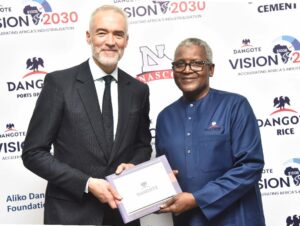
“No matter how we try to explain what we have built, you cannot fully appreciate it until you see it,” Dangote said.
“But this is only the beginning. We need to look beyond 2030. The next phase of our journey will include new investments and acquisitions as we continue to scale the business.”
The comments signal a potential new phase in Dangote Industries’ expansion strategy, moving beyond the completion and ramp-up of its major industrial projects toward further acquisitions and investments.
The group has invested heavily in Nigeria’s downstream energy and industrial sectors, most notably through its refinery, fertiliser plant and petrochemical ambitions.
$100bn revenue ambition
Dangote also said the group’s internal financial modelling had strengthened management’s confidence that its target of generating $100 billion in annual revenue by 2030 was achievable.
According to him, the projections were based on conservative assumptions, giving management greater confidence in the group’s long-term growth prospects.
The target would represent a significant expansion of Dangote Industries’ scale and would place the group among the largest African-origin corporate enterprises by revenue.
Dangote said the company’s growth expectations had also been reinforced by employee participation in the recent private placement involving the Dangote Petroleum Refinery.
He said the level of employee participation reflected confidence within the organisation in the refinery’s prospects and the broader growth strategy of the group.
A test of Africa’s industrial capacity
The Goldman Sachs visit also highlights the growing attention being paid by international financial institutions to large-scale industrial projects in Africa.
The Dangote refinery represents an attempt to move beyond Nigeria’s traditional role as a crude oil exporter by adding substantial domestic refining capacity and creating an integrated platform spanning crude processing, petrochemicals and fertiliser production.
The broader economic significance lies in the potential to retain more value from Nigeria’s hydrocarbon resources within the domestic economy.
A fully integrated industrial complex can also create linkages across logistics, manufacturing, agriculture, energy and financial services, while reducing dependence on imports of refined petroleum products and fertiliser.
For investors, however, the scale of such projects also brings significant questions around capital requirements, operating efficiency, market demand, foreign exchange exposure and the ability to sustain returns over the long term.
The Goldman Sachs assessment therefore comes at an important point in the evolution of Dangote’s industrial strategy as the group moves from building major assets to maximising their commercial potential.
Global finance delegation
The Goldman Sachs delegation included Adib N. Zouein, Co-Head of EMEA Emerging Markets Regional Sales and Head of the Middle East and North Africa region for Global Banking & Markets Public; Ryad Yousuf, Global Head of FICC Sales Strats and Structuring; and Jimi Adesanya, Head of Sub-Saharan Africa Sales, excluding South Africa.
They were received by Dangote and senior executives of the group, including Group Vice President, Oil & Gas, Devakumar Edwin; Managing Director and Chief Executive Officer of Dangote Petroleum Refinery & Petrochemicals, David Bird; and Group Executive Director, Oil & Gas, Fatima Aliko Dangote.
Other senior officials present included Chief of Staff to the President/CEO, Ibrahim Dikko; Group Chief Branding and Communications Officer, Anthony Chiejina; Group Chief Economist, Dr Hassan Mahmud; Group Chief Strategy Officer, Aliyu Suleiman; and Head of Administration, Dangote Petroleum Refinery & Petrochemicals, Musa Bala.
The engagement comes as Dangote Industries seeks to deepen its position as one of Africa’s most significant industrial groups and potentially expand its footprint through new investments and acquisitions.
For Nigeria, the bigger question is whether the industrial capacity being created can translate into sustained production, exports, employment, foreign-exchange earnings and stronger domestic supply chains.
For Dangote, the Goldman Sachs visit offered another international endorsement of the scale of the investment already made. But the group’s stated ambition beyond 2030 suggests that the next test may be less about what it has built and more about how much additional economic value it can create from it.

L-R:
Co-Head of EMEA Emerging Markets Regional Sales and head of the Middle East and North Africa (MENA) region for Global Banking & Markets – Public, Adib N Zouein; Head of Sub-Saharan Africa Sales (ex-SA) cross-asset in the Global Banking & Markets – Public, Jimi Adesanya; Group Vice President, Oil & Gas, Dangote Industries Limited; Devakumar Edwin; President/CE, Dangote Industries Limited, Aliko Dangote; Co-chief executive officer of Goldman Sachs International (GSI) and global co-head of Investment Banking, Anthony Gutman; Global head of FICC Sales Strats and Structuring, Ryad Yousuf; Managing Director/ CEO, Dangote Petroleum Refinery, David Bird during the Strategic Visit of Goldman Sachs International (GSI) to Dangote Refinery Petroleum and Fertiliser Plant, in Lagos.

Customs: Salako takes charge at Lilypond Export Command, pledges stronger trade facilitation

Eid-el-Maulud: Rite Foods calls for peace, unity, national progress

Rite Foods’ innovation, green energy drive earns top 50 impact recognition
-

 Fashion9 years ago
These ’90s fashion trends are making a comeback in 2017
-
Entertainment9 years ago
The final 6 ‘Game of Thrones’ episodes might feel like a full season
-
Fashion9 years ago
According to Dior Couture, this taboo fashion accessory is back
-
Fashion9 years ago
Model Jocelyn Chew’s Instagram is the best vacation you’ve ever had
-
Sports9 years ago
Steph Curry finally got the contract he deserves from the Warriors
-

 News9 months ago
Tinubu opens first stretch of Lagos–Calabar Coastal Highway, hints on ₦trillion legacy roads push
-
Entertainment9 years ago
The old and New Edition cast comes together to perform
-
Business9 years ago
Uber and Lyft are finally available in all of New York State