Connect with us

News

₦30bn loyalty dividend: How BUA turns long service into competitive advantage

Published

on

By Editor

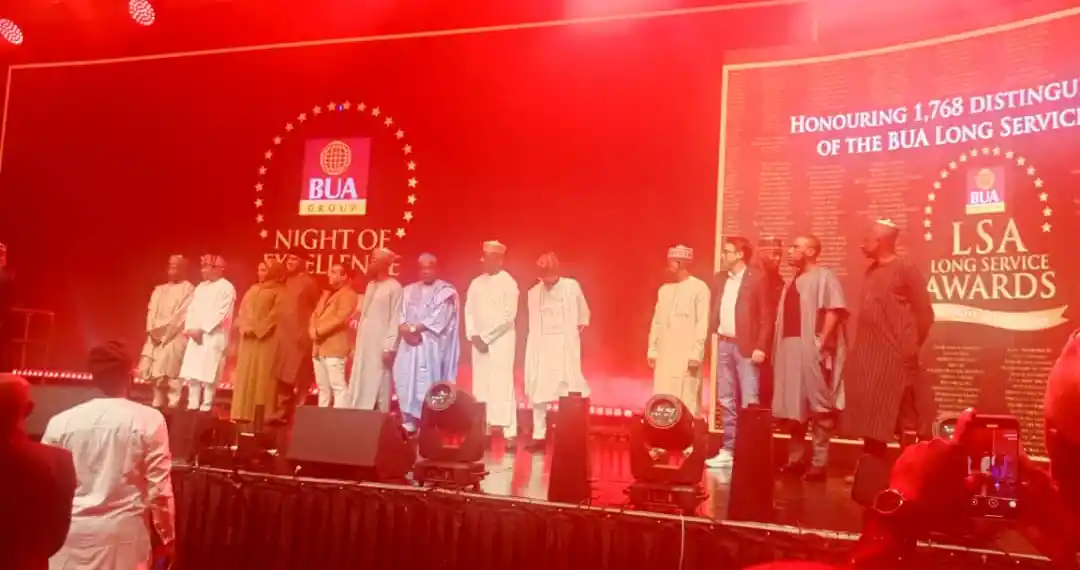
At its 2025 Night of Excellence and Long Service Awards, BUA Group, the diversified Nigerian conglomerate has disbursed a remarkable ₦30 billion in cash awards to 510 employees—one of the largest single employee reward programmes ever undertaken by a private sector company in Nigeria.

But beyond the numbers lies a deeper business narrative about culture, continuity and competitive advantage in an economy where skilled talent retention has become increasingly difficult.

The awards recognised employees whose service spans from five years to more than four decades, honouring loyalty, resilience and exceptional contribution across BUA’s sprawling operations. From cement plants and sugar refineries to food manufacturing, logistics and infrastructure assets, the message was unambiguous: enduring enterprises are built by people who stay the course.

Founded in 1988, BUA Group has grown from modest beginnings into one of Africa’s most diversified industrial groups, with core interests in cement, sugar, flour, pasta, steel, rice, real estate, ports and terminals, construction and energy. Today, its listed entities command a combined market capitalisation running into trillions of naira—an outcome, the company insists, rooted as much in human capital as in financial investment.

Speaking at the ceremony, Founder and Executive Chairman Abdul Samad Rabiu framed the evening as recognition of shared ownership in the BUA journey. He recalled that while capital, strategy and governance matter, none of BUA’s milestones would have been possible without employees who believed in the vision long before success became visible.

“Every factory built, every system strengthened, every challenge overcome, and every milestone reached carries the imprint of employees who believed in the vision long before the results were visible,” Rabiu said.

Of the ₦30 billion disbursed, 41 employees in the highest award categories received their cheques physically from the Chairman during the event, due to time constraints. These awards ranged from ₦100 million to ₦1 billion, underscoring the Group’s willingness to recognise loyalty in tangible, life-changing terms. Sixteen employees received ₦100 million each, nine received ₦200 million, seven received ₦250 million, and three received ₦500 million, while five employees walked away with ₦1 billion each.

A special award, whose cash value was not disclosed at the event, was presented to Kabiru Rabiu in recognition of his exceptional loyalty, leadership and long-standing contribution to the growth and stability of the Group.

The remaining awardees had already received—or will receive—their plaques and cheques at their various plants and operational locations nationwide, reinforcing the Group’s decentralised and inclusive culture.

Rabiu was quick to note that the cash awards, however substantial, remain symbolic. “No amount of money can fully account for decades of dedication, personal sacrifice and belief in the company’s mission,” he said. Still, in a labour market marked by rising emigration, skills shortages and disengagement, the gesture sends a powerful signal.

From a business perspective, the awards also serve a strategic function. By institutionalising long-term rewards, BUA is effectively locking in institutional memory, strengthening loyalty and reinforcing a performance culture that aligns individual success with corporate growth. It is a model of shared prosperity that contrasts sharply with short-term profit-maximisation approaches prevalent in many emerging markets.

Looking ahead, Rabiu said the Group would continue to expand capacity, invest in advanced technologies and deepen its footprint across cement, food, sugar and infrastructure. Crucially, he added, the people who built BUA would continue to grow with it.

The Night of Excellence and Long Service Awards, now a defining element of BUA Group’s culture, reflects an organisation betting that respect for people, long-term thinking and shared rewards are not just moral choices—but sound business strategy.


Continue Reading
Click to comment

Leave a Reply

Your email address will not be published. Required fields are marked *

News

Polaris bank scales preventive healthcare access with free cancer screening initiative

Published

on

By Editor

Polaris Bank has reinforced its commitment to community health and social impact with the launch of a nationwide free breast cancer screening initiative, in partnership with its NGO ally, Care Organisation and Public Enlightenment (C.O.P.E). This is coming in line with the World Cancer Day.

The initiative is aimed at driving awareness, early detection and preventive care, underscoring the Bank’s position that access to quality healthcare is fundamental to individual wellbeing and long-term economic productivity.

As part of the 2026 World Cancer Day activities, Polaris Bank will provide free, comprehensive breast cancer screening for 100 women across Nigeria. The programme complements the Bank’s ongoing sponsorship of a free prostate cancer screening exercise for 250 men aged 40 years and above nationwide.

The prostate cancer screening is currently taking place at the Men’s Clinic, located at 18 Commercial Avenue, Sabo, Yaba, Lagos, offering accessible and professional medical support to men seeking early diagnosis and preventive care.

Both health interventions align directly with the United Nations Sustainable Development Goals (SDGs), notably SDG 3 (Good Health and Well-being) through improved access to preventive healthcare; SDG 5 (Gender Equality) by prioritising women’s health; and SDG 17 (Partnerships for the Goals) through strategic collaboration with civil society organisations such as C.O.P.E.

To deepen impact, Polaris Bank will deploy educational materials, community engagement activities and digital awareness campaigns focused on early detection, healthy lifestyle choices and the importance of routine medical check-ups.

Speaking on the initiative, the Group Head, Brand Management & Corporate Communications, Rasheed Bolarinwa, stressed that early detection remains one of the most effective strategies in combating cancer.

He noted that by removing financial barriers and bringing screening services closer to communities, the Bank is empowering individuals with the knowledge and resources needed to seek timely medical intervention. The flagship breast cancer screening event is scheduled on the 21st at the C.O.P.E Centre, in Lagos.

The exercise will be conducted by trained health professionals and volunteers, providing participants with screening services alongside education on cancer prevention, self-examination and follow-up care.

Participation in the free breast cancer screening programme is open to women who are Polaris Bank account holders, subject to pre-registration and selection based on early and confirmed submissions. Eligible participants are encouraged to register via the official link provided by the Bank.

While the breast cancer screening targets women, Polaris Bank has urged men to support the health of their families by encouraging their wives, daughters and female relatives to participate.

Men aged 40 years and above are also encouraged to take advantage of the ongoing free prostate cancer screening at the Men’s Clinic in Sabo, Yaba, Lagos.

Continue Reading

News

MTN Foundation targets productivity gains as 6,000 micro-entrepreneurs go digital

Published

on

By Editor

In alignment with the Federal Government’s National Digital Economy and Small and Medium-sized Enterprises (SMEs) Development agenda, the MTN Foundation has commenced the seventh phase of its ICT Business Skills Training, onboarding 6,000 microbusiness owners across Nigeria.

The virtual training programme, which began on January 5, is designed to help aspiring entrepreneurs transition from paper-based operations to the use of simple digital tools that enhance productivity, efficiency, and business growth.

The onboarding session was facilitated by a Business Analyst, Babajide Jolaolu-Kehinde, and moderated by the Programme and Partnerships Lead, Temiloluwa Oyekanmi. Participants were introduced to the SWOT framework—Strengths, Weaknesses, Opportunities and Threats—as a practical tool for evaluating business performance and identifying priority areas for improvement.

Jolaolu-Kehinde stressed the importance of digital record-keeping, online payment adoption, and customer data tracking as essential foundations for sustainable growth. He noted that these practices align with broader government efforts to formalise and scale small and medium-sized enterprises (SMEs) across the country, emphasising that growth is driven by deliberate action and structured systems rather than optimism alone.

During the session, trainers shared real-world examples of traders who expanded their customer base by adopting digital tools such as WhatsApp, online marketplaces, mobile money platforms, and basic spreadsheet applications. Other case studies highlighted how accepting mobile transfers and using digital order channels enabled businesses to reach customers beyond their immediate locations.

A major focus of the training was the limitation of manual, paper-based operations. According to the facilitators, such systems restrict visibility into sales performance and customer behaviour, while digital tools provide real-time insights, reduce errors, and unlock access to wider markets.

At the conclusion of the onboarding, participants were encouraged to implement at least one digital improvement in their businesses. Organisers also confirmed plans for follow-up workshops and mentorship sessions to ensure sustained impact, with the training programme expected to run for an additional four weeks as part of efforts to support SME growth and Nigeria’s long-term economic development goals.




Continue Reading

News

Nigeria positions transparency as economic reform tool ahead of 2026 EITI validation

Published

on

By Editor

Nigeria is sharpening its transparency playbook in the extractive sector, not merely to meet global disclosure benchmarks but to unlock revenue, strengthen governance and restore public trust at a time of sweeping economic reforms.

That message took centre stage in Abuja as the Secretary to the Government of the Federation and Chairman of the NEITI National Stakeholders Working Group (NSWG), Senator George Akume, opened a high-level advocacy dialogue for stakeholders ahead of Nigeria’s 2026 Extractive Industries Transparency Initiative (EITI) Validation.

Addressing civil society leaders, development partners, industry players and government officials, Akume framed transparency as a strategic economic lever rather than a compliance exercise. With Nigeria grappling with fiscal pressures, revenue shortfalls and rising public expectations, he said the extractive sector—long the backbone of government earnings—must be governed with greater openness, efficiency and accountability to realise its full value.

“The extractive sector remains central to Nigeria’s economic stability, revenue mobilisation and long-term development aspirations,” Akume noted, while acknowledging that governance gaps and inefficiencies have historically limited its impact.

A key highlight of the dialogue was the formal introduction of the new Executive Secretary of the Nigeria Extractive Industries Transparency Initiative (NEITI), Musa Sarkin Adar. Akume congratulated him on his appointment and expressed confidence in his ability to steer NEITI at a critical juncture, as transparency reforms increasingly intersect with broader fiscal and economic restructuring.

Significantly, Akume revealed that NEITI’s reports—once viewed largely as diagnostic documents—are now actively shaping policy and reform in Nigeria’s oil, gas and mining sectors. According to him, findings and recommendations from NEITI audits have become essential tools in driving ongoing sector reforms, marking a shift from transparency for transparency’s sake to transparency as a catalyst for change.

The dialogue also spotlighted the rising importance of the 2023 EITI Standard, which places greater emphasis on outcomes rather than disclosures alone. For Nigeria, this means deploying transparency data to plug revenue leakages, improve sector oversight, strengthen institutions and ensure that natural resource wealth translates into tangible benefits for citizens.

“As a country, we must go beyond compliance. EITI should serve as a reform instrument that supports domestic revenue mobilisation, prudent fiscal management and inclusive governance”, Akume said.

Discussions at the forum centred on Nigeria’s recent EITI Assessment, the upcoming Validation process and the unveiling of a policy brief titled “Beyond Assent: Pathways for Implementing Nigeria’s New Tax and Revenue Framework.” The brief, Akume explained, aligns extractive sector governance with the government’s wider economic reform agenda and provides practical pathways for improving tax administration and revenue capture.

Underlying the entire conversation was NEITI’s multi-stakeholder model, which Akume described as the initiative’s greatest strength. He stressed that transparency cannot be delivered by government alone, underscoring the critical roles of civil society, the private sector, sub-national actors, the media and development partners.

“This is why dialogues like this matter. They create space for honest reflection, constructive engagement and shared ownership of reforms”, he said.

As Nigeria prepares for its 2026 EITI Validation, the Abuja dialogue signalled a clear shift in tone and intent: transparency is no longer just a governance ideal, but a business-critical and reform-driven strategy for stabilising revenues, strengthening investor confidence and securing long-term economic resilience.


Continue Reading

Trending