Connect with us

News

Lagos pushes to reverse $2bn medical tourism losses, targets West Africa healthcare hub

Published

on

By Ambrose Nnaji

The Lagos State Government has intensified efforts to reverse Nigeria’s multi-billion-dollar medical tourism outflow and position Lagos as a regional healthcare destination, as infrastructure upgrades, specialist training and private sector partnerships begin to reshape the state’s health system.

Immediate past Permanent Secretary, Lagos State Ministry of Health, Segun Ogboye, said the state had spent the last six to eight years implementing reforms aimed at reducing outbound medical travel while attracting patients from other African countries.

Speaking during the Nigeria-South Africa Chamber of Commerce (NSACC) Breakfast Forum, on the topic Global Care, Local Confidence: ‘Positioning Nigeria in the Medical Tourism Value Chain’, in Lagos, Ogboye described healthcare as a major global business, noting that Nigeria loses billions of dollars annually to foreign hospitals due to weak infrastructure, skills gaps and lack of public confidence in local facilities.

According to him, global health tourism is valued at about $8.2 billion, with Nigeria accounting for a significant share of outbound spending, largely from Lagos and Abuja.

He said estimates show Nigerians spent between $1.2 billion and $2 billion annually on overseas treatment between 2020 and 2022, with figures fluctuating in recent years due to foreign exchange constraints and changes in payment channels.

“Health is a huge business. Unfortunately, healthcare providers focus on saving lives, but the financial value in the sector is enormous, and much of it leaves the country through medical tourism,” he said.

Ogboye explained that Lagos adopted a deliberate policy to reverse medical tourism by strengthening health infrastructure, expanding specialist care and encouraging public-private partnerships.

Projects underway include the development of new specialist hospitals, executive medical facilities and diagnostic centres designed to meet international standards.

Among them is the new Massey Children’s Hospital, described as one of the most advanced pediatric facilities in sub-Saharan Africa, as well as the upgrading of the Lagos State University Teaching Hospital to provide executive health screening and high-end specialist care.

He said the state also concessioned the development of the Medipark medical complex to private investors to accelerate the creation of a modern healthcare cluster capable of attracting foreign patients.

Despite the investments, Ogboye said Nigeria’s health sector still faces major structural challenges, including shortage of specialists, high cost of medical equipment and the migration of doctors and nurses abroad.

He noted that many government-sponsored specialists fail to return after overseas training, weakening the country’s capacity to deliver complex procedures locally.

“We trained many doctors abroad, but only a few returned. Without skilled manpower, even the best hospitals become museums,” he said.

He added that expensive equipment maintenance and lack of biomedical engineers also limit the ability of hospitals to sustain advanced services.

Ogboye stressed that expanding health insurance coverage is critical to building a viable healthcare economy, noting that Nigeria still records about 70 percent out-of-pocket spending, one of the highest globally.

He said Lagos has made health insurance mandatory, but enrollment remains low, limiting investment in hospitals.

Digitisation of medical records, stronger regulation of private hospitals and improved emergency care systems are also part of the reforms aimed at restoring public trust.

He identified India, the United Kingdom, the United States, South Africa and Turkey as top destinations for Nigerians seeking treatment abroad, driven by perceived quality, faster service and better facilities.

However, he said Lagos could compete globally if current reforms are sustained.

“If we complete the infrastructure, retain our health workers and improve regulation, Lagos can become a medical tourism hub not just for Nigeria, but for West Africa,” he said.

Ogboye, a public health expert with over two decades in civil service, played key roles in Lagos’ HIV/AIDS programme, COVID-19 response and health sector reforms before retiring from the ministry.

He currently consults on health systems development and hospital management.

Chairman of the Nigeria-South Africa Chamber of Commerce, Ije Jidenma, agreed that Nigeria has reached a critical turning point in its healthcare development and must urgently reposition itself within the global medical tourism value chain to stop capital flight and unlock billions of dollars in investment opportunities,

Jidenma said healthcare delivery has evolved into one of the fastest-growing sectors in the global economy, with medical tourism alone accounting for billions of dollars annually as countries compete to attract patients seeking quality and affordable treatment.

She noted that Nigeria has historically remained a source market for outbound medical tourism, with thousands of citizens travelling abroad every year for specialised procedures, leading to significant capital flight.

According to her, Nigeria loses between $1 billion and $2 billion annually to overseas medical treatment, driven by demand for advanced care in oncology, cardiology, kidney transplants and other specialised procedures.


“The key question before us is how Nigeria can move from being primarily a source market to becoming a destination within the global medical tourism value chain,” she said.

Jidenma observed that recent foreign exchange constraints have reduced overseas medical spending, forcing more Nigerians to seek treatment locally, a development he described as an opportunity to strengthen domestic healthcare capacity.

He said available data shows medical tourism spending dropped sharply in the first half of 2025 compared to the previous year, partly due to forex shortages but also because more advanced procedures are now being performed within Nigeria.

“Necessity is the mother of invention. Because foreign exchange has become difficult, we are seeing more procedures done locally, and that is helping to build domestic capacity,” she said.

Despite the emerging progress, Jidenma identified major structural challenges limiting Nigeria’s ability to compete globally, including underfunding of the health sector, shortage of equipment, low insurance penetration, brain drain among medical professionals and weak regulation.

He also cited frequent strikes, high out-of-pocket spending and poor standardisation of healthcare services as factors pushing Nigerians to seek treatment abroad.

According to him, building local confidence in the health system is critical to reversing the trend.

“Confidence fuels demand, demand attracts investment, and investment drives excellence. Without local confidence, medical tourism cannot grow,” she said.

Jidenma called for stronger collaboration between Nigeria and South Africa to develop joint healthcare investments, training programmes and cross-border hospital partnerships that could position both countries as leaders in Africa’s medical tourism market.

He said South Africa has developed strong expertise in hospital management, specialist care and medical standards, which Nigeria could leverage through structured partnerships.

“Africa can retain its healthcare spending within the continent if we collaborate effectively through joint ventures, knowledge exchange and cross-border investments,” she said.

He urged government and private investors to prioritise public-private partnerships, specialist hospitals, improved insurance coverage and diaspora engagement to accelerate sector growth.

Jidenma also proposed the creation of regional medical hubs, medical visa systems and a coordinated national branding strategy to promote Nigeria as a healthcare destination.

According to him, developing a complete medical tourism ecosystem — including immigration support, insurance integration, hospitality services and internationally accredited hospitals — will be necessary to compete with countries such as India, Turkey, Thailand and South Africa.

“If we can deliver quality care locally under the right conditions, Nigerians will stay, foreigners will come, and the healthcare sector will become a major economic driver,” she said.

She added that the private sector, financial institutions and governments must work together to transform healthcare from a social service into a strategic investment sector capable of generating jobs, foreign exchange and long-term economic growth.


Continue Reading
Click to comment

Leave a Reply

Your email address will not be published. Required fields are marked *

News

BREAKING: Nigeria’s merchandise trade hits N34.8tn in Q1 2026 as exports rise, imports drop

Published

on

By Editor

Nigeria’s total merchandise trade stood at N34,788.59 billion in the first quarter of 2026, according to fresh data released by the National Bureau of Statistics (NBS).

The report shows a mixed trade performance, with exports recording steady growth while imports declined significantly within the review period.

Total exports rose to N21,169.27 billion in Q1 2026, representing a 2.77percent increase compared to N20,598.48 billion in the same period of 2025. It also reflects an 11.63percent rise from N18,963.41 billion recorded in Q4 2025.

In contrast, total imports dropped to N13,619.33 billion, marking an 18.17percent decline year-on-year from N16,644.42 billion in Q1 2025, and a sharper 21.05percent fall compared to N17,250.93 billion in Q4 2025.

The data points to a narrowing import bill and stronger export performance in the early months of 2026.

Details later…

Continue Reading

News

Rite Foods, Promasidor highlight family wellbeing as key to national growth

Published

on

By Editor

Rite Foods Limited and Promasidor Nigeria have called for stronger family support systems, improved child wellbeing, and greater efforts to tackle inequalities affecting millions of Nigerian households as the world marks the 2026 International Day of Families.

The companies, in separate statements commemorating the annual event observed globally on May 15, stressed the need for collective action to address disparities in access to nutrition, education, healthcare, and economic opportunities that continue to impact children and vulnerable families.

This year’s theme, “Families, Inequalities and Child Wellbeing,” highlights growing concerns over widening social and economic gaps and their effects on child development and family stability.

Rite Foods said the occasion aligns with its broader commitment to supporting Nigerian families through quality products, responsible business practices, and people-focused initiatives.

Speaking on the significance of the day, the Managing Director of Rite Foods, Seleem Adegunwa, described families as the foundation of every society, noting that unequal access to essential needs often leaves children most vulnerable.

“Families are at the heart of every society. When access to nutrition, education, healthcare, and opportunity becomes unequal, children are often the most affected. At Rite Foods, we believe every child deserves the chance to grow, thrive, and dream bigger regardless of background,” he said.

Adegunwa added that the company remains committed to delivering quality products that cater to the needs of Nigerian families while maintaining strong connections with everyday consumer realities.

Rite Foods’ product portfolio includes Bigi Carbonated Soft Drinks, Fearless Energy Drinks, Sosa Fruit Drink, Bigi Premium Table Water, Rite Spicy, Bigi Beef, and Bigi Flex Sausages, consumed across different parts of the country.

Also speaking, the company’s Head of Corporate Affairs and Sustainability, Ekuma Eze, stressed the importance of collaboration among businesses, communities, and policymakers in addressing inequality and improving child welfare.

“Real progress happens when businesses, communities, and policymakers work together. Supporting families goes beyond the products we make. It is about creating environments where people feel supported, included, and empowered to succeed,” he said.

Similarly, Promasidor Nigeria emphasised the importance of investing in family welfare and child development as critical pillars for sustainable national growth.

According to the company, conversations around child wellbeing should go beyond awareness campaigns and translate into long-term investments that strengthen family structures and improve access to nutrition and opportunities.
 

The Chief Executive Officer of Promasidor Nigeria, François Gillet, said the wellbeing of children reflects the strength of society’s foundations.

“Families are the foundation of every society, and the well-being of children reflects the strength of that foundation. Addressing inequalities that limit access to proper nutrition and care is essential to sustainable development,” he said.

Gillet noted that Promasidor’s mission has consistently focused on making quality nutrition accessible to households, especially amid current economic pressures facing many Nigerian families.

Promasidor’s brands, including Cowbell, Loya Milk, Onga, Top Tea, Kremela, Twisco, and Miksi, continue to support nutrition and daily nourishment in millions of homes nationwide.

The company also highlighted its broader social impact initiatives, including the Ikun Dairy Farm in Ekiti State, which promotes local economic inclusion, as well as education-focused programmes aimed at empowering young Nigerians.

Promasidor stated that improving child wellbeing requires sustained investments in systems and policies that strengthen families and create equal opportunities for children to grow in safe, healthy, and supportive environments.

Both companies reiterated that stronger families are critical to building resilient communities and fostering long-term national development.
 

Continue Reading

News

Nigeria Prize for Science breaks record with 237 entries for 2026 innovation race

Published

on

By Editor

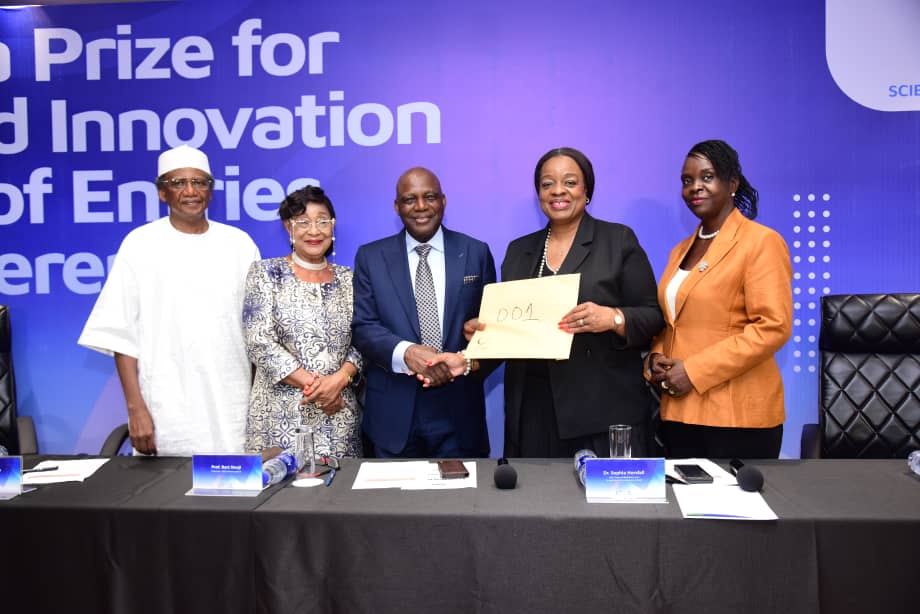
(2nd Right) GM, External Relations and Sustainable Development, NLNG, Sophia Horsfall, presenting entries for The Nigeria Prize for Science and Innovation to the Chairman of the Prize’s Advisory Board, Prof. Barth Nnaji, at a press conference, in Lagos.

The 2026 edition of The Nigeria Prize for Science and Innovation has reached a new milestone with a record 237 entries, the highest number of submissions since the award was established in 2004.

The entries were formally handed over to the Prize’s Advisory Board during a press conference in Lagos on Thursday, officially commencing the adjudication process for what remains one of Africa’s most prestigious science awards.

This year’s competition retains the theme, “Innovations in ICT, Artificial Intelligence (AI), and Digital Technologies for Development,” a continuation of the 2025 focus area. The previous edition ended without a winner after no submission met the benchmark required by the judges.

Speaking at the handover ceremony, Sophia Horsfall, General Manager, External Relations and Sustainable Development at Nigeria LNG Limited, said the continued emphasis on digital innovation reflects both global technological trends and Nigeria’s development priorities.

According to her, the Prize is designed to identify innovations capable of delivering measurable socio-economic impact.
 

“In this fourth industrial revolution, digital infrastructure is becoming as essential as electricity and water. Nigeria’s economic sustainability depends on our ability to move from promising research to transformative innovation that delivers real solutions,” Horsfall stated.

She stressed that the organisers remain committed to maintaining world-class standards, noting that international recognition for Nigerian innovation must be earned through rigorous evaluation.

“We believe that if a Nigerian discovery is to command global respect, it must withstand the highest levels of scrutiny. That conviction informed the difficult decision taken seven months ago,” she added, referring to the decision not to declare a winner in 2025.

While acknowledging the strong interest generated by the digital technology theme, Horsfall maintained that only innovations demonstrating scalability, originality, and practical relevance would qualify for consideration.

Receiving the entries on behalf of the Advisory Board, Barth Nnaji described the handover as a critical phase in the selection process, reiterating that the credibility of the Prize rests on uncompromising standards of excellence.

“Our refusal to award the prize in 2025 was not a rejection of the efforts of Nigerian innovators. Rather, it reaffirmed that The Nigeria Prize for Science and Innovation upholds a gold standard of excellence,” he said.

Nnaji explained that submissions would continue to undergo rigorous intellectual and technical scrutiny based on originality, depth, relevance, and demonstrable impact.

He added that the Prize is particularly interested in innovations capable of solving real-life national challenges.

“Our broader objective is to identify solutions that address Nigeria’s pressing needs, whether through digital health technologies for underserved communities or AI-driven tools for preserving cultural heritage and indigenous languages,” he noted.

Other members of the Advisory Board include Nike Akande and Yusuf Abubakar.

Now in its 22nd year, The Nigeria Prize for Science and Innovation is valued at $100,000 and is widely regarded as Africa’s leading science and innovation award. The winner of the 2026 edition is expected to be announced at a world press conference in September.
Continue Reading

Trending